
Because the right system starts with the actual building.
A heat-load calculation is the foundation for equipment sizing, airflow, duct design, humidity control, comfort, and permit documentation. Without it, every decision after that begins with an assumption.
Direct answer: Heat-load calculations are necessary because they determine how much heating and cooling a home actually needs at the selected design conditions. The result supports equipment selection, duct design, room airflow, humidity control, and code documentation.

Homes of the same size can require very different systems.
Floor area does not describe the windows, orientation, insulation, ceilings, infiltration, ventilation, ducts, or climate that create the load.
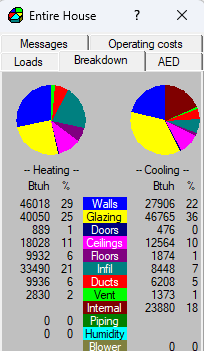
Walls, roofs, floors, windows, and doors transfer heat.
Construction assemblies and insulation levels influence how quickly heat enters or leaves the home.
Infiltration and ventilation add outdoor air.
Uncontrolled leakage and planned ventilation both change heating, cooling, and moisture loads.
Orientation and design weather change the result.
Solar gain, outdoor temperature, humidity, and local design conditions affect the load differently by location and room.
The central point: The load belongs to the building. Equipment should be selected after the load is known—not the other way around.
Heat gain in summer. Heat loss in winter.
A residential load calculation estimates how much heat enters the home during cooling conditions and how much heat leaves the home during heating conditions.
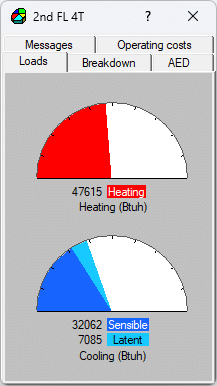
The cooling calculation also separates sensible load from latent load. Sensible load changes temperature. Latent load represents moisture that must be removed from the indoor air.
That distinction is critical in humid climates, where a system can have enough total capacity and still be a poor match for moisture removal.
For a deeper explanation, see Heat Gain and Heat Loss and Hot-Humid Climate Load Calculations.
The load calculation is the first step in a larger design process.
Model the home
Enter the building, climate, orientation, and construction details.
Calculate loads
Determine whole-house and room-by-room requirements.
Select equipment
Use Manual S and manufacturer performance data.
Assign airflow
Translate room loads into room airflow targets.
Design ducts
Use Manual D to size and route the distribution system.
A shortcut at the first step affects every decision that follows. An inaccurate load weakens equipment selection, airflow, duct sizing, and comfort.
Guessing creates predictable problems.
| Without a documented load calculation | Possible result |
|---|---|
| Equipment selected by square footage | Oversizing, undersizing, or poor moisture performance |
| Existing tonnage copied | Old sizing mistakes are repeated |
| Room loads omitted | Hot and cold rooms, weak airflow, and poor balance |
| Latent load ignored | Cool-but-clammy indoor conditions |
| Ducts sized by habit | Noise, high static pressure, low airflow, and uneven delivery |
| Envelope changes ignored | New windows, insulation, air sealing, and additions are not reflected |
| Permit documentation incomplete | Review comments, revisions, or delayed approval |
Bigger equipment is not a safety factor.
Oversized cooling equipment can satisfy the thermostat rapidly and shut off before enough moisture is removed. It can also create frequent cycling, uneven temperatures, and airflow requirements the duct system cannot support.
Oversized heating equipment can produce short cycles and large temperature swings. In either mode, the home may reach setpoint without feeling consistently comfortable.
Read more about oversized HVAC and humidity problems and why Manual J is more reliable than rule-of-thumb sizing.
Correct sizing is not about choosing the smallest possible system. It is about matching the equipment’s actual performance to the calculated heating, sensible cooling, and latent cooling requirements.

Projects where old assumptions no longer apply.
- New construction
- HVAC replacement
- Home additions
- Major renovations
- Window replacement
- Insulation or air-sealing upgrades
- Attic encapsulation
- Duct relocation
- Equipment-type changes
- Persistent comfort complaints
- High indoor humidity
- Permit or code documentation
Any project that changes the envelope, conditioned area, ventilation, ducts, or equipment should be evaluated from the current building conditions—not from the size of the previous system.
Total capacity does not tell you how to distribute the air.
A whole-house load supports the total equipment decision. A room-by-room load calculation shows how the total requirement is divided among the spaces.
Those room loads become airflow targets. Manual D then uses the room airflow, equipment airflow, available static pressure, route length, and fitting losses to size the duct system.
Without room-by-room data, air is often divided by habit or floor area. That can leave high-load rooms under-supplied and low-load rooms over-supplied.
Whole-house load sizes the system. Room-by-room load helps balance the house.
The final number should be traceable to the building inputs.
Indoor and outdoor assumptions
The report should identify the design temperatures, location, and relevant climate conditions.
Envelope, glazing, infiltration, and ducts
The construction assumptions should agree with the plans or known existing conditions.
Heating, sensible, latent, and room loads
The report should provide enough detail to support equipment selection and airflow decisions.
Heat-load calculation FAQ
Why are HVAC load calculations necessary?
They determine how much heating and cooling the actual home requires and provide the basis for equipment selection, room airflow, duct sizing, humidity control, and permit documentation.
Can HVAC equipment be sized by square footage?
Square footage alone does not account for climate, orientation, windows, insulation, infiltration, ventilation, ceilings, ducts, or room exposure. It cannot reliably establish the building load.
Is the existing HVAC size enough for replacement?
No. The existing system may have been sized incorrectly, and the home may have changed through renovations, air sealing, insulation, windows, additions, or duct modifications.
What is the difference between heat gain and heat loss?
Heat gain is the heat entering the home during cooling conditions. Heat loss is the heat leaving the home during heating conditions. Both are calculated from the building and design weather.
Does a load calculation include humidity?
A residential cooling-load calculation separates sensible cooling from latent cooling. Latent load represents the moisture that must be removed from the indoor air.
Does Manual J select the equipment?
Manual J calculates the loads. Manual S is the equipment-selection procedure that compares those loads with manufacturer performance data.
Does a load calculation include duct sizing?
No. Manual J provides whole-house and room loads. Manual D uses room airflow, equipment airflow, available static pressure, effective length, and fitting losses to size the ducts.
How do I start a load-calculation project?
Use the pricing and project-start page to choose the needed service and submit the plans, project location, and available construction information.
Continue through the residential design process.
The complete guide connecting the building, equipment, and airflow.
Open the pillar guide →How heating, sensible cooling, latent cooling, and room loads are calculated.
Explore Manual J →How manufacturer performance is matched to the calculated loads.
Explore Manual S →How room airflow becomes a residential duct system.
Explore Manual D →Why total tonnage does not explain individual room needs.
Read the room-load guide →Why shortcut sizing cannot replace a building calculation.
Compare the methods →How excessive cooling capacity can create cold-but-clammy conditions.
Read the humidity guide →Where heating and cooling loads come from in a residential building.
Understand the loads →Choose the calculation package and submit plans and project information.
See pricing and start →Replace sizing assumptions with a documented load.
Send the plans, project location, and construction details. We will review the home and prepare the selected residential load-calculation and design documents.