Why Do Building Departments Require a Certified Manual J?
Modern building inspector boards and regional planning authorities no longer accept square-footage rule-of-thumb approximations for equipment permits. To satisfy the International Energy Conservation Code (IECC) and strict regional adaptations like the **Florida Building Code (Energy Conservation)**, mechanical systems must be backed by accurate, coordinate-mapped thermodynamic boundary verification. A certified load calculation explicitly guarantees your equipment matches the structure's real sensible and latent heat realities.
The Engineering Execution Matrix: Beyond the Box Checklist
Uncredentialed online estimators treat all structures identical. True mechanical design maps fluid dynamics, heat radiation variables, and ambient moisture values against historical ASHRAE local weather records to protect indoor climate integrity.
| ACCA Protocol Section | Engineering Computational Metric | Critical Compliance Output Focus |
|---|---|---|
| Manual J Protocol | Thermodynamic Boundary Evaluation | Calculates exact **Sensible (Temperature)** and **Latent (Moisture)** heat spikes across directional fenestration boundaries and envelope structural insulation coefficients. |
| Manual S Protocol | Equipment Capacity Matrix Optimization | Verifies modern **A2L Refrigerant transitions** (R-454B / HFC-32), evaluating compressor operational balance sheets against calculated sensible/latent peak metrics. |
| Manual D Protocol | Aerodynamic Static Pressure Distribution | Designs total structural duct architecture, velocity thresholds, and CFM balancing criteria to eliminate dead leg rooms and persistent system back-pressure stress. |
| Manual N Protocol | Light Commercial HVAC Sizing Calculations | Processes intricate ventilation matrices, high internal lighting heat gains, and volatile occupancy fluctuations for office hubs, strip centers, and multi-tenant packages. |
ACCA Protocols: Precision System Engineering
We work directly alongside high-performance mechanical contractors, premier custom home builders, and commercial architectural groups who demand absolute mathematical precision over guesswork.
Residential Load Analysis
Precise mapping of structural U-values, solar heat gain coefficients (SHGC), and specific boundary limits to establish baseline cooling and heating demands.
Equipment Selection Verification
Analyzing manufacturer performance verification sheets to ensure total capacity matches sensible and latent design criteria perfectly without unsafe oversizing.
Duct Infrastructure Architecture
Full layout calculation of structural duct networks, verifying external static pressure bounds to guarantee uniform thermal comfort across all zones.
Commercial Mechanical Sizing
Comprehensive ventilation and envelope evaluation for light commercial zones, retail centers, and professional assemblies demanding specialized code criteria.
Municipal Code & Regional Permitting Landing Guides
Building departments enforce distinct localized code interpretations, regional environmental extremes, and mandatory submittal packages (such as the **Florida EnergyCode Form R405**). Access your target jurisdiction directory below:
Expert Manual J, S, and D Load Calculations
By Licensed Mechanical Contractors
How is a Manual J calculation performed for 2026 code compliance?
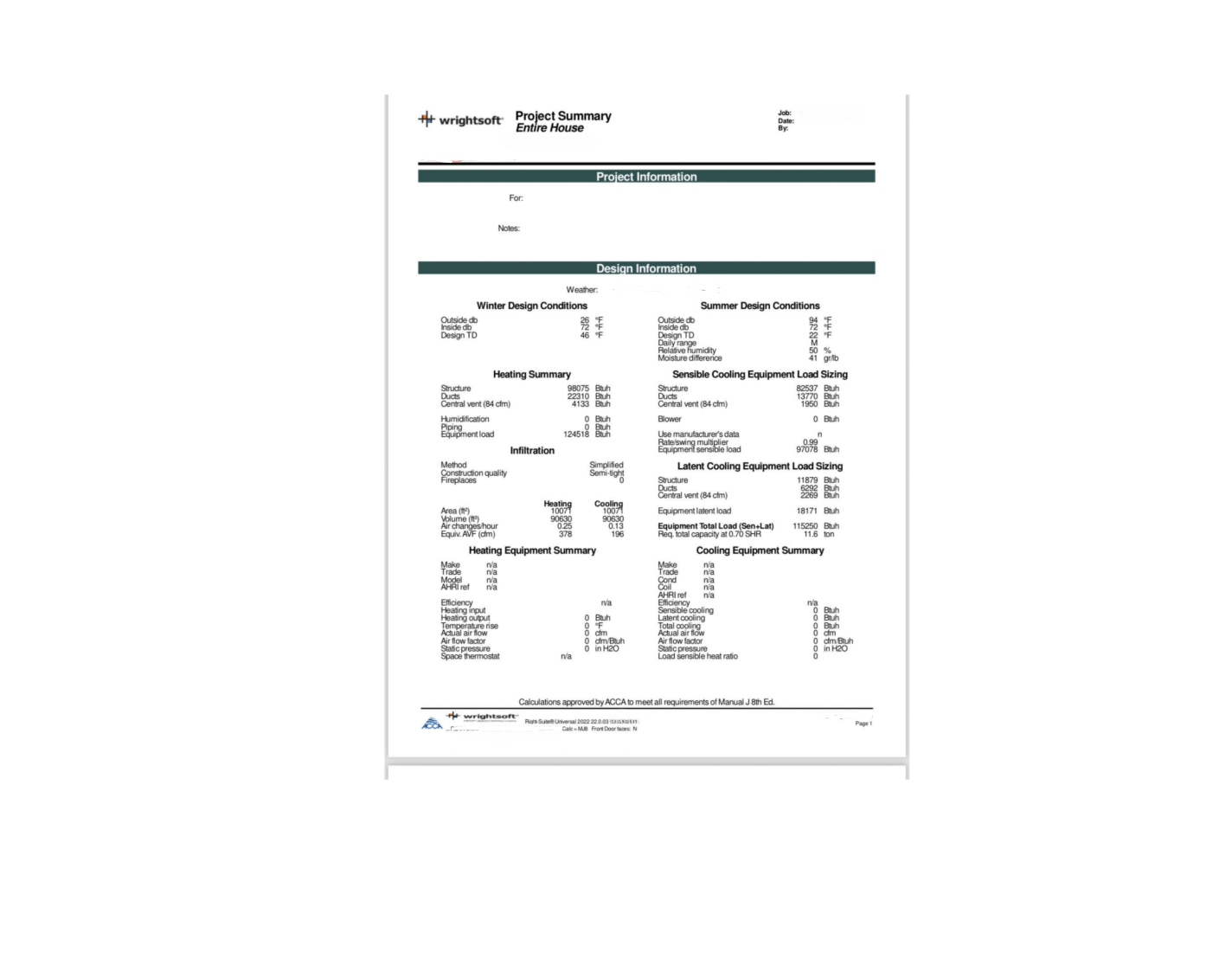
A professional Manual J calculation is performed by modeling the building envelope in ACCA-approved software (like Wrightsoft), factoring in local IECC climate data, window SHGC ratings, and the specific latent heat profiles of new A2L refrigerant systems to prevent oversized equipment and humidity issues.
A professional Manual J calculation is required to ensure your HVAC system is not oversized. Systems that are too large short-cycle, leading to high humidity and premature equipment failure. We provide the precise BTU data required for building permits and system longevity.
Key Changes for 2026 Mechanical Designs:
-
Lower Latent Capacity: Many new A2L-compatible coils have different moisture-removal profiles. In high-humidity zones like Florida (Zone 1), a mismatched Manual J can result in "wet" air and mold issues.
-
Airflow Criticality: A2L systems often require specific airflow rates to ensure safety sensors don't trigger a shutdown. A precise Manual D (Duct Design) is mandatory to keep these systems running.
-
Charge Limits: Building codes now limit the amount of refrigerant in a system based on the square footage of the room. If your load calculation is wrong and you install a system that is too large, you may technically be in violation of safety codes. (learn more)
Instant Manual J Pricing. No Waiting.
- Instant Pricing for Manual J Load Calcs (PLUS! Choose Equipment Selection Manual S ) & Send Your Plans Right from Upload
We accept architectural drawings, specs, or sketches with dimensions. - Your home or building is modeled in WrightSoft software using ACCA Manual J standards.
- Receive the Report
You’ll get a clear, permit-ready PDF report with all required data and recommendations. - (Optional) Add Full HVAC System and Duct Design
Need duct layouts and equipment schedules? We can provide a complete design package.
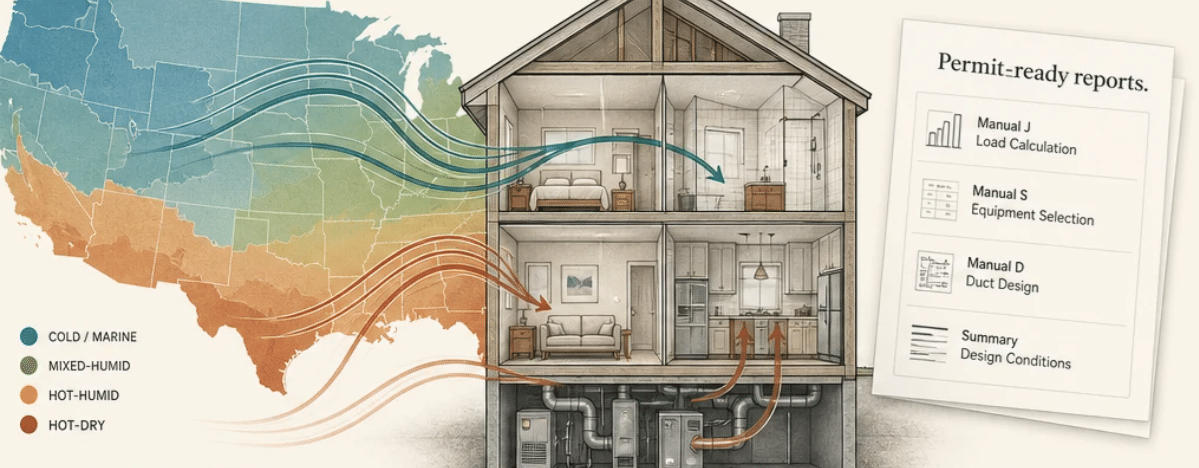
HVAC Load Calculations Built to Your Climate Zone
Manual J, S, and D Load Calculations: U.S. Service Areas
Southeastern U.S. (Hot-Humid & Mixed-Humid)
-
Florida: Miami, Tampa, Orlando, Jacksonville, Fort Lauderdale, Ft. Myers, Cape Coral, Boca Raton, Naples, Punta Gorda, Sarasota, Panama City Beach.
-
Georgia: Atlanta, Augusta, Columbus, Decatur, Macon, Marietta, Savannah.
-
Alabama: Birmingham, Huntsville, Mobile, Montgomery.
-
The Carolinas: Charlotte, Raleigh, Greensboro, Asheville, Charleston (SC), Columbia, Greenville.
-
Tennessee: Nashville, Memphis, Knoxville, Chattanooga.
-
Deep South: New Orleans, Baton Rouge, Shreveport, Little Rock, Jackson (MS).
Northeastern & Mid-Atlantic U.S. (Cold & Mixed-Humid)
-
New England: Boston, Worcester, Springfield (MA), Providence, Manchester, Burlington, Bridgeport, Hartford, New Haven, Stamford.
-
Tri-State & Mid-Atlantic: New York City, Buffalo, Rochester, Albany, Newark, Jersey City, Paterson, Philadelphia, Pittsburgh, Allentown, Wilmington (DE), Baltimore.
-
Virginia & WV: Virginia Beach, Richmond, Norfolk, Charleston (WV).
Midwestern U.S. (Cold & Extreme Cold)
-
Great Lakes: Chicago, Detroit, Grand Rapids, Lansing, Cleveland, Columbus (OH), Cincinnati, Toledo, Milwaukee, Madison, Green Bay.
-
Plains & Central: Indianapolis, Fort Wayne, Des Moines, Cedar Rapids, Wichita, Overland Park, Kansas City (MO/KS), St. Louis, Springfield (MO), Omaha, Lincoln, Fargo, Bismarck, Sioux Falls, Rapid City.
Western & Mountain U.S. (Arid, Marine, & High Altitude)
-
California: Los Angeles, San Francisco, San Diego, San Jose, Sacramento, Fresno.
-
Mountain: Denver, Colorado Springs, Aurora, Boise, Billings, Cheyenne, Salt Lake City, Albuquerque, Santa Fe.
-
Southwest: Phoenix, Tucson, Mesa, Las Vegas, Reno, El Paso.
-
Pacific Northwest: Seattle, Spokane, Tacoma, Portland (OR), Eugene, Salem.
How to Submit Your Request for a HVAC Load Calculation (Instant Load Calculator Pricing)
- Submit Your Plans: Email your blueprints or sketches for a professional review.
- Climate Zone Analysis: We determine your exact IECC design temperatures.
- Manual J Sizing: We calculate the peak heating and cooling loads (BTUs).
- Manual S & D Selection: We select the equipment and design the ductwork for balanced airflow.
- Final Report Delivery: You receive a permit-ready PDF for your building department.
Over 35 Years HVAC Field Experience & Designing
HVAC Design Services for Homes as Small as 1300 Sq Ft to 50,000+
Every Design Prioritizes Precision, Comfort & Fast Turnaround
Every design is tailored to your specific IECC Climate Zone to ensure peak performance in regional climates.
Fast Turn Around Time
Get your Load Calcs in record time, accurately produced and code compliant.
Code Compliant
Our Manual J, D, S are ACCA Code Compliant & ready for inspection!
Licensed Designers
Over 35+ Heating and Air Expertise in the Field. Specializing in HVAC Systems Designs.
Led by our design team bringing over 35 years of boots-on-the-ground HVAC experience to every project. Unlike "online-only" calculators, we are licensed Mechanical Contractors who have spent decades in the field installing, maintaining, and engineering high-performance systems across the United States.
Our expertise isn't just theoretical—we hold active Mechanical Contractor Licenses in Florida, Georgia, Alabama, North Carolina, and South Carolina. This deep regional knowledge allows us to navigate the strict 5th and 6th Edition Energy Conservation Codes that other firms often overlook.
As active members of ACCA and ASHRAE, we stay at the forefront of the industry’s shift toward A2L Refrigerants and high-efficiency inverter technologies. Whether you are a homeowner in Florida, Dallas, or a contractor in Louisiana, Georgia, we ensure your Manual J, S, and D reports are technically flawless, permit-ready, and optimized for your specific climate zone.
Caribbean HVAC Design Services (Expansion 2027)
-
Greater Antilles: Havana, Santiago de Cuba, Kingston, Montego Bay, Port-au-Prince, Santo Domingo, San Juan, Ponce, Bayamón.
-
Lesser Antilles: Bridgetown, Castries, Port of Spain, Oranjestad, Willemstad, Kralendijk, St. George's, Basseterre, Roseau.
-
Virgin Islands & Bahamas: Charlotte Amalie, Christiansted, Road Town, Nassau, Freeport.
-
Territories: The Valley, Brades, Gustavia, Marigot, Philipsburg, Cockburn Town.
Trusted by HVAC Industry Professionals. Where Precision Matters.
How to Get a Load Calculation Completed
1. MANUAL "J" HEAT LOAD
A Manual J load calculation determines a home's heating and cooling needs based on precise factors. First, it analyzes square footage, insulation, windows, and climate to calculate heat gain and loss. Then, it considers occupancy, appliances, and airflow to refine the results. Next, the data helps select the right HVAC size for maximum efficiency. Without it, an oversized unit short cycles, causing humidity issues and wasted energy. Conversely, an undersized system struggles, leading to discomfort and higher bills. Therefore, a Manual J calculation ensures comfort, efficiency, and cost savings. Finally, professional HVAC design prevents future problems and extends system lifespan.
2. MANUAL "S" EQUIPMENT SELECTION
A Manual S equipment selection ensures the chosen HVAC system matches the Manual J load calculation results. First, it considers heating and cooling capacities to prevent inefficiency. Then, it factors in blower performance, fan speed, and manufacturer specifications. Without it, oversized units cycle poorly, while undersized ones struggle. Therefore, proper selection maximizes comfort, efficiency, and system longevity. Finally, a well-matched system reduces energy costs and prevents future performance issues
3. MANUAL "D" DUCT DESIGN
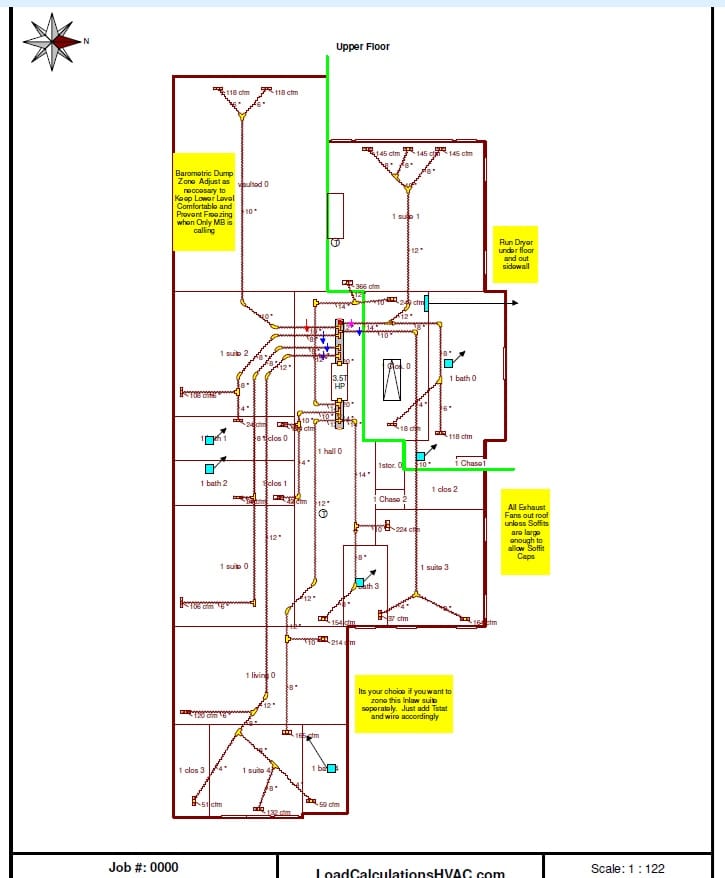
A Manual D duct design carefully ensures balanced airflow, leading to consistent heating and cooling throughout the home. First, it accurately calculates duct sizes based on Manual J, ensuring precise airflow distribution. Next, it thoroughly considers factors like friction loss, static pressure, and equipment compatibility to optimize performance. Without this critical step, poor airflow quickly leads to uncomfortable hot and cold spots. As a result, improper design reduces efficiency and shortens system lifespan. On the other hand, a properly designed system significantly improves comfort, efficiency, and long-term reliability. Furthermore, well-planned ducts help reduce noise, minimize energy waste, and lower maintenance costs. Ultimately, investing in professional duct design ensures a more efficient and comfortable home.
Is Your Project Permit-Ready
The HVAC Design Compliance Checklist
Before you submit your mechanical plans, ensure your documentation meets these IECC and ACCA requirements:
-
[ ] Manual J: Does the calculation use the correct Outdoor Design Temperature for your specific city?
-
[ ] Manual S: Is the equipment's Total & Sensible Capacity matched to the Manual J results (not just nominal tons)?
-
[ ] Manual D: Does the duct design account for External Static Pressure and friction loss of your specific blower?
-
[ ] Orientation: Has the "North" orientation of the house been verified? (A 90-degree shift can change the load by 15-20%).
-
[ ] Building Envelope: Are the window U-factors and SHGC values pulled from the actual building specs?
-
[ ] Infiltration: Is the air leakage (ACH) based on current local energy code requirements
All Three Services- Manual J, D, and S - Fast Turnaround
Learn more about Manual J, Manual D, and Manual S
Manual J Service
A proper Manual J HVAC load calculation and duct design not only ensures your home runs efficiently
Manual S (Equipment Selection)
Manual S contains detailed technical and operational specifications on many different brands of HVAC systems
Learn More
Manual D (Duct Design)
Beyond Manual J load calculations, we also specialize in customized Manual D Duct Design for new construction and remodels.
How the 2026 A2L Refrigerant Transition Impacts Your Manual J & S Calculations
The 2026 transition to A2L (low-GWP) refrigerants, such as R-454B and R-32, requires more precise HVAC load calculations. Because A2L systems have different heat transfer properties and narrower operating envelopes, an oversized system—traditionally a "safe" margin for contractors—now risks major efficiency losses, sensor errors, and voided manufacturer warranties.
Why "Close Enough" Sizing Is No Longer an Option
For decades, the industry relied on R-410A. However, as we move into 2026, the new A2L refrigerants are slightly flammable and highly sensitive to pressure. This means your Manual S (Equipment Selection) must be an exact match to your Manual J (Load Calculation).
Why Precision Matters: Manual J vs. Rule of Thumb
| Feature | Rule of Thumb (Guesswork) | Manual J Precision (Our Service) |
| Sizing Basis | General Sq. Ft. (e.g., 500 sq ft per ton) | Insulation, Window U-Values, & Orientation |
| Climate Accuracy | Ignores local design temperatures | Uses exact IECC Climate Zone data |
| Humidity Control | Often oversized; leads to "cold and clammy" air | Optimized Latent Load removal for comfort |
| Equipment Life | Short-cycling leads to premature failure | Balanced cycles extend system longevity |
| Operating Cost | 20-30% higher due to inefficiency | Maximum energy savings and lower bills |
| Permit Ready | Often rejected by building departments | 100% ACCA Code Compliant and permit-ready |
Licensed. Certified. Accredited & 35+ Yrs of HVAC Design
We work closely with homeowners, builders, and architects to find cost-effective solutions while prioritizing energy efficiency. Because of our commitment, we consistently deliver exceptional results. We utilize Wrightsoft Software to ensure every Manual J heat gain/loss analysis is optimized for high-efficiency inverter systems and geothermal applications. Additionally, our extensive industry expertise ensures reliable and efficient solutions. Therefore, clients trust us to meet their unique needs with precision. The team's dedication sets us apart in the industry.