
Manual D Duct Design, Drawn on Your Plans
A duct design you can actually build from — trunks, branches, and returns drawn right on the plan, not a spreadsheet that stays in the truck.
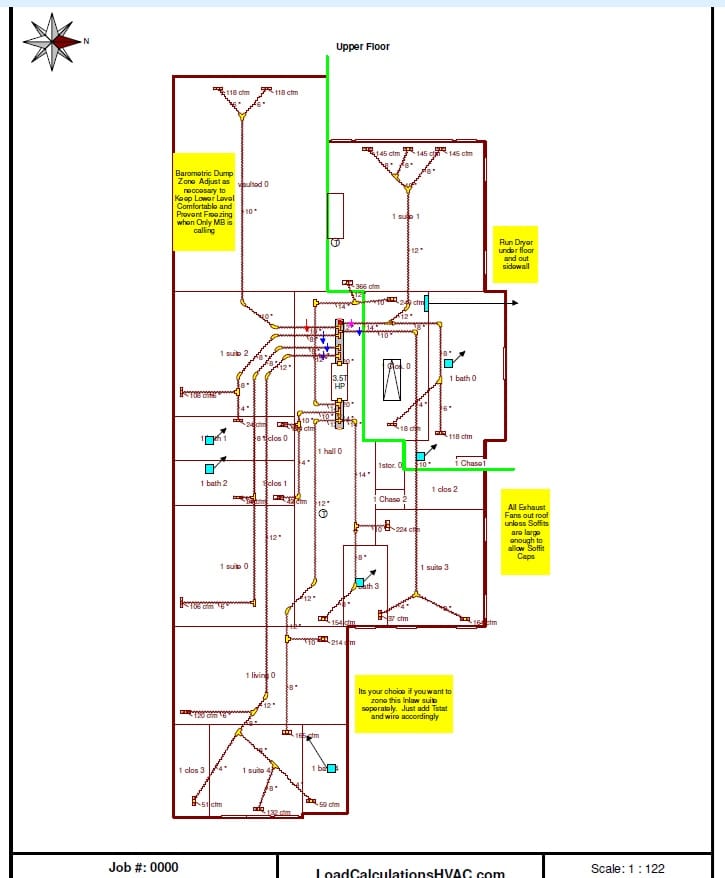
Manual D is the ACCA standard for residential duct design. It sizes every supply and return so the system delivers the right airflow to each room at a static pressure the blower can actually handle. The calculation produces the numbers — but the part you build from is the duct layout drawn on the plans: trunk routing, branch sizes, takeoff and register locations, and return paths, marked where they belong.
- Manual D sizes ducts to the room-by-room airflow that a Manual J load calculation produces.
- The duct’s job is to deliver design airflow without exceeding the blower’s available static pressure.
- Fittings — elbows, boots, takeoffs — add far more resistance than the straight pipe they replace.
- An undersized duct system chokes a correctly sized furnace or air handler, so the equipment can’t perform.
- What we deliver is the duct design drawn on your plan sheets, ready for the field.
Here is the thing the software companies don’t tell you: a Manual D spreadsheet, on its own, is close to useless on a job site. No installer has ever hung trunk line off a column of friction-rate numbers. The calculation is the engine; it tells you what size each run has to be. But the deliverable a contractor builds from is the drawing — the ductwork laid out on the actual plan, sized run by run, with takeoffs and registers placed where they go.
That is how we deliver it, and it is the difference between a report that gets filed and a design that gets installed correctly. We’ve been doing residential duct layouts since 1995. Houses are our specialty; we also take on select light commercial, such as small offices and recreation centers, and we work nationwide.

What is a Manual D duct design?
Manual D is the ACCA procedure for sizing a residential duct system so it delivers the airflow each room needs without overworking the blower. It starts from the room-by-room airflow figures a Manual J produces, then works out the size of every trunk, branch, and return required to carry that air. Done right, the result is a balanced system: the rooms that need more air get bigger ducts, the rooms that need less get smaller ones, and the whole system operates inside the pressure the equipment was built for.
Why the drawing matters more than the report
A duct calculation answers “what size?” A duct drawing answers “what size, where, and how does it get there?” — which is the only version of the question that matters once someone is standing in the attic with sheet metal.
A spreadsheet of duct sizes leaves every routing decision to whoever is installing it. Run the trunk the wrong way and a 7-inch branch that was correct on paper now feeds a room through three extra elbows it was never sized for. The drawing settles that on the plan, in advance: the trunk goes here, it steps down there, this takeoff is a 6-inch to the back bedroom, the return comes from this central location. Nothing is left to a guess made under a roof in August.

What actually determines duct size?
Duct size is not a function of room size or a rule of thumb. It comes from two things: how much air a room needs, and how much pressure the system has to spend moving it. The major inputs:
| Input | What it controls |
|---|---|
| Room airflow (CFM) | How much air each room needs — taken directly from the Manual J room loads. |
| Available static pressure | What’s left of the blower’s rated pressure after the coil, filter, and grilles take their share. |
| Total effective length | The longest supply-plus-return path, including the equivalent length of every fitting on it. |
| Friction rate | Available pressure divided by total effective length — the value that sizes every duct. |
| Fitting losses | Elbows, takeoffs, and boots, each of which adds far more resistance than straight pipe. |
Is rule-of-thumb duct sizing good enough?
No — and it’s one of the most common reasons a brand-new, correctly sized system underperforms. “A 6-inch goes to a bedroom” ignores how far that bedroom is, how many turns the run takes, and how much pressure is actually available to push air through it.
| Rule-of-thumb sizing | Manual D design | |
|---|---|---|
| Basis | Habit — “this size usually works” | Calculated airflow and available pressure |
| Fitting losses | Ignored | Counted as equivalent length |
| Run length | Ignored | Drives the friction rate |
| Typical result | High static pressure, starved rooms | Design airflow to every room |
| What you build from | A guess in the field | A drawing on the plan |
When ducts are undersized, static pressure climbs, the blower can’t move the air it was rated for, and rooms at the end of long runs never get comfortable. The equipment isn’t the problem — the path the air has to travel is. A proper Manual D prevents that before a single duct is hung.
How Manual D connects to Manual J and Manual S
Duct design is the third step, and it only works if the first two are right:
- Manual J — load calculation: the room-by-room heating and cooling loads, which set the airflow each room needs.
- Manual S — equipment selection: matching real equipment to that load, which fixes the blower and its available pressure.
- Manual D — duct design: sizing and routing the ducts to deliver that airflow within that pressure — drawn on your plans.
Skip Manual J and the airflow targets are guesses. Skip Manual D and even perfectly sized equipment is feeding ducts that can’t carry the air. Get all three right and the system performs the way the homeowner was promised.
What you receive
A clean duct design laid out on your plan sheets: trunk routing, every branch sized, takeoff and register locations marked, and return-air paths shown — everything an installer needs to build the system as designed, and everything an inspector needs to see that it was designed at all. The underlying Manual D calculations come with it, but the drawing is the part you’ll actually use.
Frequently asked questions
What is a Manual D duct design?
It is the ACCA-standard method for sizing a home’s supply and return ducts so the system delivers the right airflow to each room without exceeding the blower’s available static pressure.
Why do you deliver duct drawings instead of just a report?
Because a system is built from a drawing, not a spreadsheet. Ductwork drawn on the plans shows trunk routing, branch sizes, and register locations, so the install matches the design instead of leaving routing to a field guess.
What information is needed for a Manual D?
The room-by-room airflow from a Manual J load calculation, the selected equipment and its blower data, and the floor plan the ducts will be routed on.
Is rule-of-thumb duct sizing accurate?
No. Rules of thumb ignore run length and fitting losses, which often leaves the system with high static pressure and rooms that never get enough air.
What happens if ducts are undersized?
Static pressure rises, the blower can’t move its rated airflow, and comfort suffers even when the furnace or air handler is correctly sized.
Do you work nationwide?
Yes. We provide residential duct design across the country, plus select light commercial such as small offices and recreation centers.
Get a duct design you can build from
Your ductwork sized and drawn on the plans, to ACCA Manual D, sized to your actual loads. We work with builders, contractors, and homeowners nationwide.
See pricing & start your duct design →Static Pressure Comparison: High vs. Ideal
This chart illustrates what happens when the "External Static Pressure" (ESP) is out of balance.
| Feature | Ideal Static Pressure (e.g., 0.5" w.c.) | High Static Pressure (e.g., 0.9"+ w.c.) |
| Blower Motor Performance | Runs efficiently at designed RPM. | Works "overtime," leading to overheating. |
| Airflow Volume (CFM) | Meets Manual J requirements for every room. | CFM drops; rooms at the end of the run stay hot. |
| System Noise | Whisper-quiet operation. | High-pitched "whistling" or air turbulence noise. |
| Energy Consumption | Low; system cycles as intended. | High; motor draws more Amps to fight resistance. |
| Indoor Air Quality | Proper filtration without air bypass. | Air may "leak" out of unsealed joints due to backpressure. |

Manual D uses the ACCA method to determine the correct duct sizes and layout for your HVAC system. After calculating your air conditioning needs, we assess your equipment and how air will be distributed. From there, we design the duct system to ensure proper airflow, providing optimal comfort in every room.