
Manual J Load Calculation, Done Right
A real load calculation built on more than thirty years of judgment — not a square-footage guess and not a number copied from the old system.
A Manual J load calculation is the ACCA-standard method for determining a home’s true peak heating and cooling loads, room by room, so HVAC equipment is sized to the actual building instead of a rule of thumb. Done correctly it accounts for orientation, glazing, insulation, air leakage, ventilation, and internal gains — the factors that actually drive the load. Skipping it is the single most common reason home systems end up oversized.
- Manual J calculates the load; Manual S selects the equipment; Manual D sizes the ducts.
- Square-footage rules of thumb almost always oversize — the opposite of a safety margin.
- A floor plan alone is missing roughly two-thirds of what an accurate Manual J requires.
- An oversized system short-cycles, never removes humidity, and wears out early.
- We work nationwide on residential projects, plus select light commercial.
Most heating and cooling systems in American homes are too big — not by a little, by a lot. The reason is almost always the same: nobody did a real Manual J. They eyeballed it, ran a tons-per-square-foot rule of thumb, or copied whatever was in the house before. The result is equipment that short-cycles, never pulls out humidity, wears out early, and costs more to run while keeping the house less comfortable.
We’ve been doing residential load calculations since 1995 — thousands of homes and the kind of judgment that only comes from the repetition. We work nationwide for builders, contractors, and homeowners who want the number right the first time. Houses are our specialty; we also take on select light commercial, such as small offices and recreation centers.
What does a Manual J load calculation account for?
A proper Manual J is a room-by-room accounting of every path heat takes into and out of a building, evaluated at your local design conditions. The major inputs:
| Load source | What it captures |
|---|---|
| Conduction | Heat through walls, ceilings, windows, doors, and floors, based on real assemblies and R-values. |
| Solar gain | Heat through glazing, which varies sharply by orientation, size, and glass specification. |
| Infiltration | Uncontrolled air leakage through the building envelope. |
| Ventilation | Controlled fresh air the home requires, which becomes a real conditioned load. |
| Internal gains | Heat from people, lighting, and appliances. |
| Latent load | The moisture portion of the cooling load — the part rules of thumb ignore entirely. |

Add it all up and you get the honest peak heating and cooling load — the number your equipment should be sized to. That is a very different thing from “the last system was a 4-ton, so we’ll put in a 4-ton.”
Why does correct HVAC sizing matter?
Oversizing is not a safety margin. It is a comfort and durability problem. An oversized system blasts to temperature and shuts off before it can dehumidify, leaving a house cold and clammy in summer, then cycling on and off all day — more wear, more noise, a shorter equipment life, and higher bills. Undersizing has the opposite failure mode: the system runs constantly and never catches up on a design day. An accurate Manual J is what lands you between the two.
Is a square-footage rule of thumb accurate?
No. The internet is full of “load calculators” that ask for square footage and a climate zone and return a tonnage. They feel scientific. They are not — and they are wrong in a predictable direction.
| Rule of thumb / online calculator | True Manual J | |
|---|---|---|
| Inputs | Square footage, climate zone | Room-by-room envelope, glazing, orientation, infiltration, gains |
| Orientation & solar | Ignored | Calculated glazing by glazing |
| Latent (moisture) load | Ignored | Calculated separately |
| Typical result | Oversized | Right-sized to the actual load |
| Accountability | None | A real person stands behind the number |
Can you size HVAC equipment from a floor plan alone?
No — not accurately. A floor plan looks like it has everything, but it only carries a fraction of what a Manual J actually needs. The rest has to be read from other sheets, confirmed, or supplied by judgment.
| What Manual J needs | On the floor plan? |
|---|---|
| Ceiling heights | No — they live on the sections and elevations. Assuming 8′ mis-sizes every vaulted and tray ceiling. |
| Window U-factor & SHGC | Rarely — often only a tag pointing to a schedule on another sheet, if at all. |
| True orientation | Only if the north arrow exists and is correct — and the same plan faces a different way on every lot. |
| Wall assemblies & insulation | No — not on the architectural sheets. |
| Infiltration & duct location | No. |
The plan gives you geometry. Everything that makes the answer correct — the assemblies, the orientation, the real ceiling volumes — comes from reading the full drawing set and knowing what to question. Start from incomplete inputs and you get a confident-looking number that’s wrong from the first line.
Why a human still does this better
The very best architectural drawings are still drawn by hand — not because firms can’t afford CAD, but because a hand-drafted set shows a mastery a plotter can’t fake. The craft was never in rejecting the tool. It was in knowing what the tool can’t judge.
A load calculation is the same. The software handles the arithmetic; the judgment is ours. Is that ceiling really 8 feet, or is half the great room open to eighteen? Is the north arrow believable? Are these the real wall assemblies, or the optimistic ones? Does the input set even make physical sense? Our number has more than thirty years behind it and a real person accountable for it — defensible at permit, at inspection, and when the system has to actually perform.
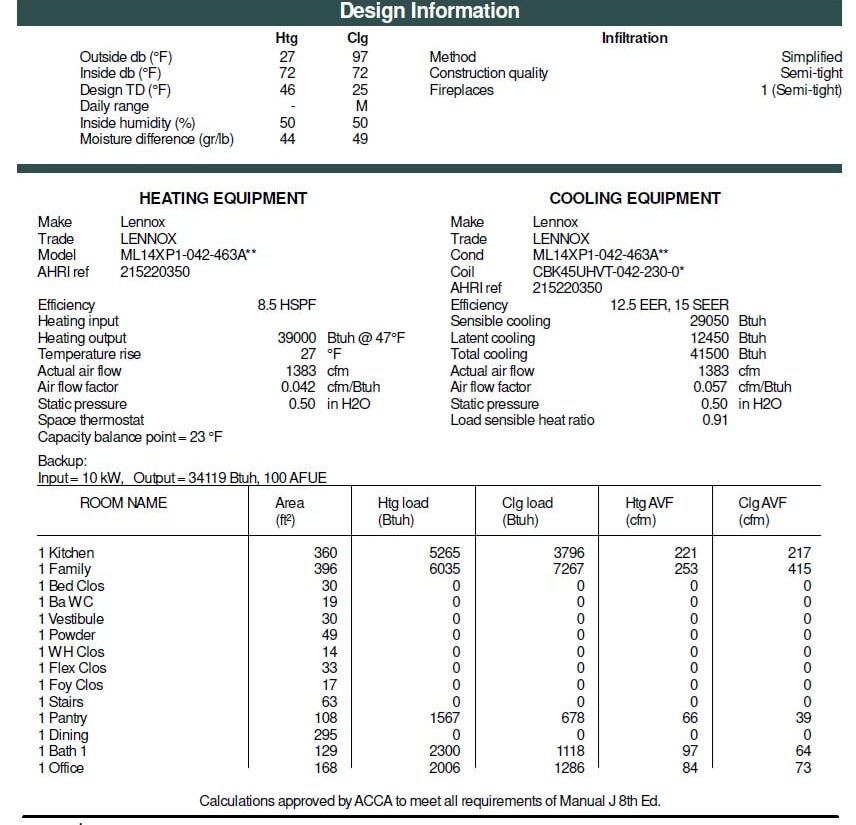
What we check that a quick estimate misses
- True conditioned volume — vaulted, tray, and open-to-below spaces, not a flat ceiling assumption.
- Real solar orientation, glazing by glazing, because west glass and north glass are not the same problem.
- Makeup air for serious kitchen exhaust. Two 1,200-CFM hoods don’t show up on a load calc — they show up as a depressurization and combustion-safety problem the calc was never meant to catch.
- Tight-home ventilation load. A well-sealed house doesn’t mean cutting the equipment in half — you trade uncontrolled leakage for controlled, conditioned fresh air, and that air gets counted.
- A sanity check of the result against the physics of heat gain and heat loss, so a bad input never becomes a confident-looking report.
How Manual J fits with Manual S and Manual D
A load calculation is step one, not the whole job. The right number feeds the right equipment and the right ductwork:
- Manual J — load calculation: the true peak heating and cooling load.
- Manual S — equipment selection: matching real equipment to that load at your actual conditions, instead of rounding up to the next box.
- Manual D — duct design: sizing the ducts to deliver that capacity to every room, quietly and at the right pressure.
Get all three right and the system performs the way the homeowner was promised. Skip the first one and the other two are built on a guess. See our full overview of the HVAC design chain.
What to send us
- Floor plans or dimensioned sketches
- Project location (city and state)
- Window and door details (size, U-factor, SHGC)
- Insulation R-values (attic, walls, floors)
- Building orientation (which direction the home faces)
- Known equipment preferences or permit requirements
We review what you send, confirm the project details, and let you know if anything else is needed before work begins. Most residential projects are completed within 24–48 hours of receiving complete information.
Manual J across every climate
We run Manual J calculations for residential projects across all 50 states. The methodology is the same everywhere — the design conditions change to match the specific climate of each project. City-specific pages with local design conditions and permit context:
See our full areas served page for the complete list organized by climate zone.
Frequently asked questions
What is a Manual J load calculation?
It is the ACCA-standard method for determining a home’s peak heating and cooling loads, room by room, so HVAC equipment is sized to the actual building rather than to a rule of thumb.
How much does a Manual J load calculation cost?
Manual J load calculations are priced at $0.14 per square foot with a $350 minimum. A full design package including Manual S equipment selection and Manual D duct design starts at $990. See our pricing page for the complete rate schedule including add-ons for ERV selection and duct design.
How long does a Manual J take?
Most residential projects are completed within 24 to 48 hours of receiving complete plans and project information. Complex projects or architectural duct layouts may need additional review time — we confirm the timeline upfront before work begins.
Do I need a Manual J for a permit?
In most jurisdictions, yes. The International Energy Conservation Code and most state energy codes require a Manual J load calculation for new construction and HVAC replacements requiring a permit. A rule-of-thumb estimate does not satisfy the requirement. We deliver permit-ready reports formatted for building department submittal across all 50 states.
Why is correct HVAC sizing important?
Oversized equipment short-cycles, fails to remove humidity, wears out faster, and costs more to run. An accurate Manual J prevents that by sizing to the true load.
Is a square-footage rule of thumb accurate?
No. Rules of thumb ignore orientation, glazing, insulation, infiltration, and internal gains, and almost always oversize the system.
Can you size HVAC equipment from a floor plan alone?
Not accurately. A floor plan omits ceiling heights, glazing specifications, true orientation, and wall assemblies — so it has to be combined with the rest of the drawing set and professional judgment before the load is trustworthy.
What is the difference between Manual J, Manual S, and Manual D?
Manual J calculates the load, Manual S selects equipment to match that load, and Manual D sizes the ductwork to deliver it.
What software do you use?
We use WrightSoft Right-Suite Universal — the ACCA-accredited software standard for residential Manual J, S, and D calculations. Every report we deliver is produced in WrightSoft using ACCA methodology.
Do you work nationwide?
Yes. We provide residential load calculations across the country, plus select light commercial such as small offices and recreation centers.
Get an accurate Manual J — anywhere in the country
A clean, defensible, ACCA-standard load calculation, done by someone who knows when a number is wrong. We work with builders, contractors, and homeowners nationwide.
See pricing & start your load calculation →