
Areas We Serve
We provide residential Manual J, S, and D calculations for contractors, builders, architects, and homeowners across the entire United States — remotely, from your plans, with no site visit required.
Every state. Every climate zone. Same methodology.
The ACCA Manual J process is the same whether the project is in Miami or Minneapolis. The design conditions change — the rigor does not. Send us your plans from anywhere in the country and receive a permit-ready report in 24–48 hours.
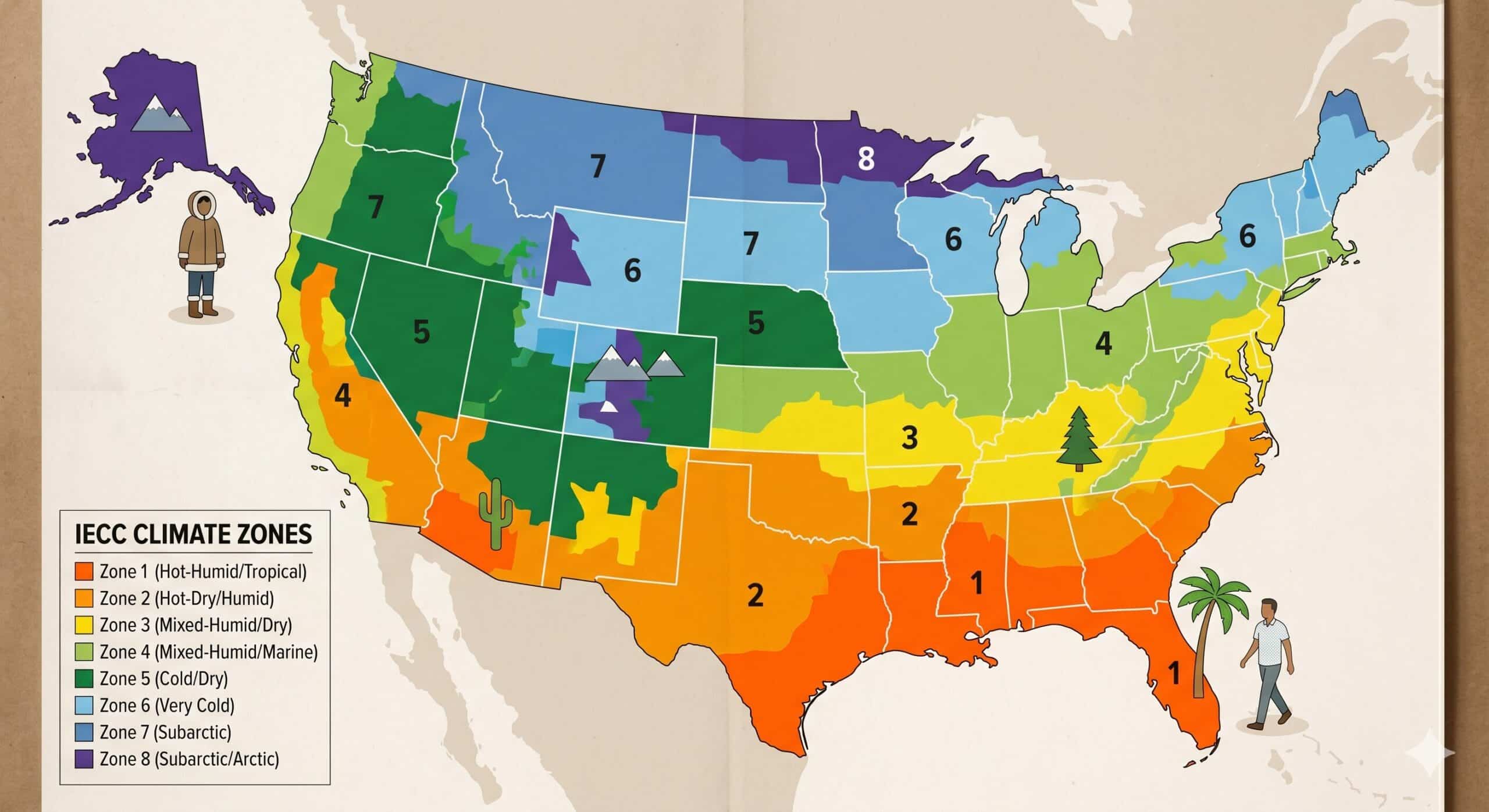
IECC climate zones define the design conditions for every Manual J load calculation. A home in Zone 1A (hot-humid South Florida) and a home in Zone 6 (cold Minnesota) require fundamentally different calculations — and fundamentally different equipment.
Our services — available everywhere
Manual J Load Calculation
Room-by-room heating and cooling loads using your actual design conditions. The foundation every equipment and duct decision is built on.
Learn about Manual J →Manual S Equipment Selection
Equipment matched to real manufacturer performance at your design conditions — total, sensible, and latent capacity all verified.
Learn about Manual S →Manual D Duct Design
Duct system sized to deliver the calculated airflow to every room — built from your plans, not a field estimate.
Learn about Manual D →How remote HVAC load calculations work
Every project we run is done remotely — no site visit required, no local office needed. You send your plans, we model the home in WrightSoft Right-Suite Universal using ACCA Manual J methodology and your project’s actual design conditions, and we return a permit-ready PDF report. The process is the same whether the project is in Florida or Montana.
What we need from you: floor plans or dimensioned sketches, the project location, window and door details, insulation R-values, building orientation, and any known permit requirements. We confirm scope before work begins and deliver within 24–48 hours on most residential projects.
See our pricing page for rates, or send your plans directly to get started.
Nationwide service. Local design conditions. One standard of accuracy.
Permit-ready Manual J, S, and D reports for residential projects across all 50 states — in 24–48 hours.
See pricing and get started Send your plans