
Yes—an oversized HVAC system can leave a house cool and clammy.
Cooling equipment removes heat and moisture at the same time. When a system is too large, it may satisfy the thermostat so quickly that the cooling cycle ends before enough moisture is removed from the air.
Direct answer: Oversized air-conditioning equipment can cause humidity problems because short cooling cycles reduce dehumidification runtime. Correct sizing begins with a Manual J load calculation and continues with Manual S equipment selection to verify sensible and latent performance.
Short cycle
Temperature drops quickly, but coil runtime may be too short for strong moisture removal.
Longer, steadier cycle
Longer operation supports more stable temperatures and more consistent dehumidification.
This is a simplified visual. Actual humidity control also depends on coil temperature, airflow, latent capacity, infiltration, ventilation, and duct conditions.
The thermostat measures temperature—not whether the house feels dry.
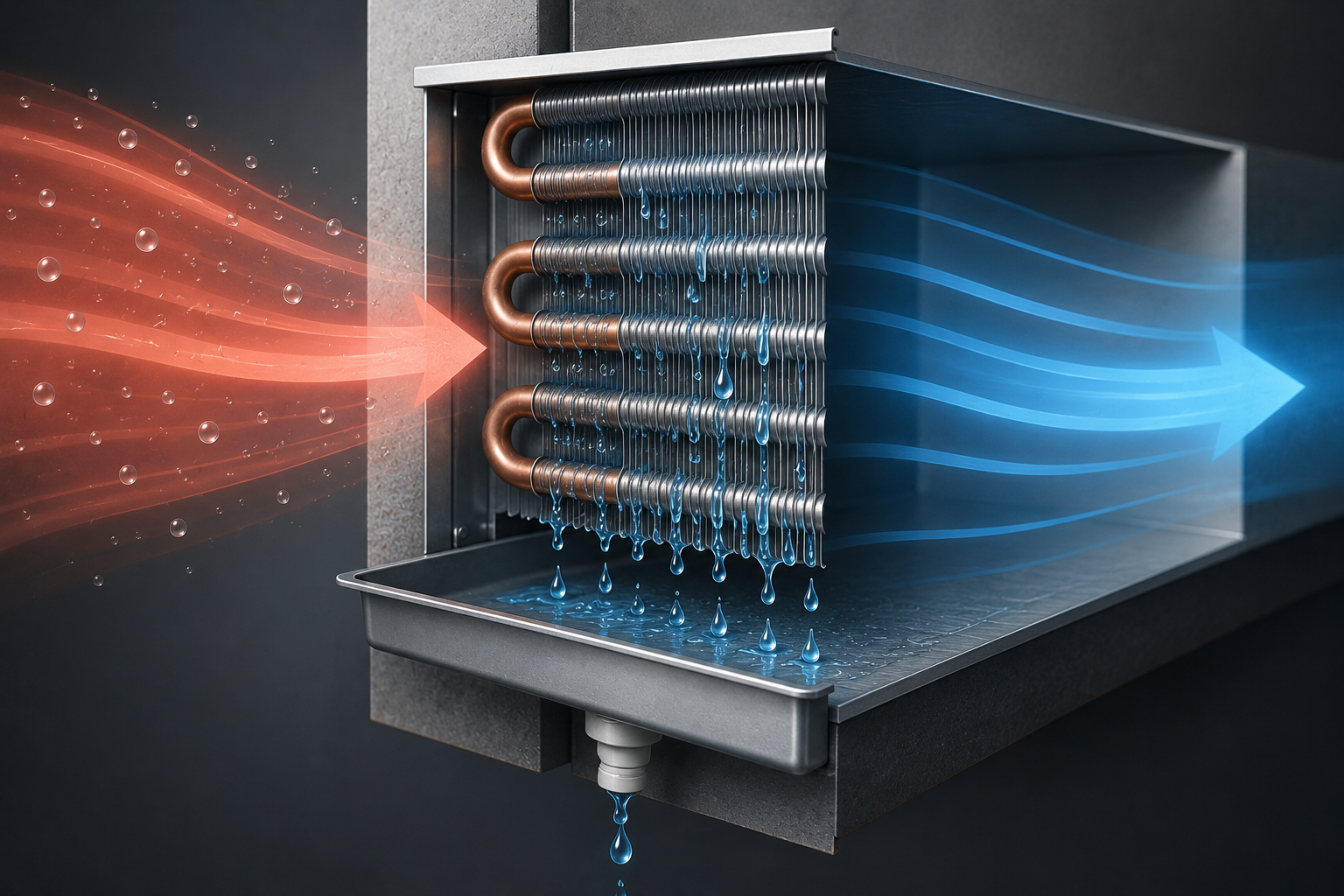
During cooling, warm indoor air passes over a cold evaporator coil. The air temperature falls, and water vapor can condense on the coil when the surface is cold enough. That moisture drains away from the home.
An oversized system can pull the air temperature down rapidly, satisfy the thermostat, and shut off before the coil has operated long enough to remove the expected amount of moisture. The house may feel cold, sticky, or clammy even though the thermostat shows the desired temperature.
This is especially important in hot-humid climate load calculations, where latent cooling can be a large part of the total load.
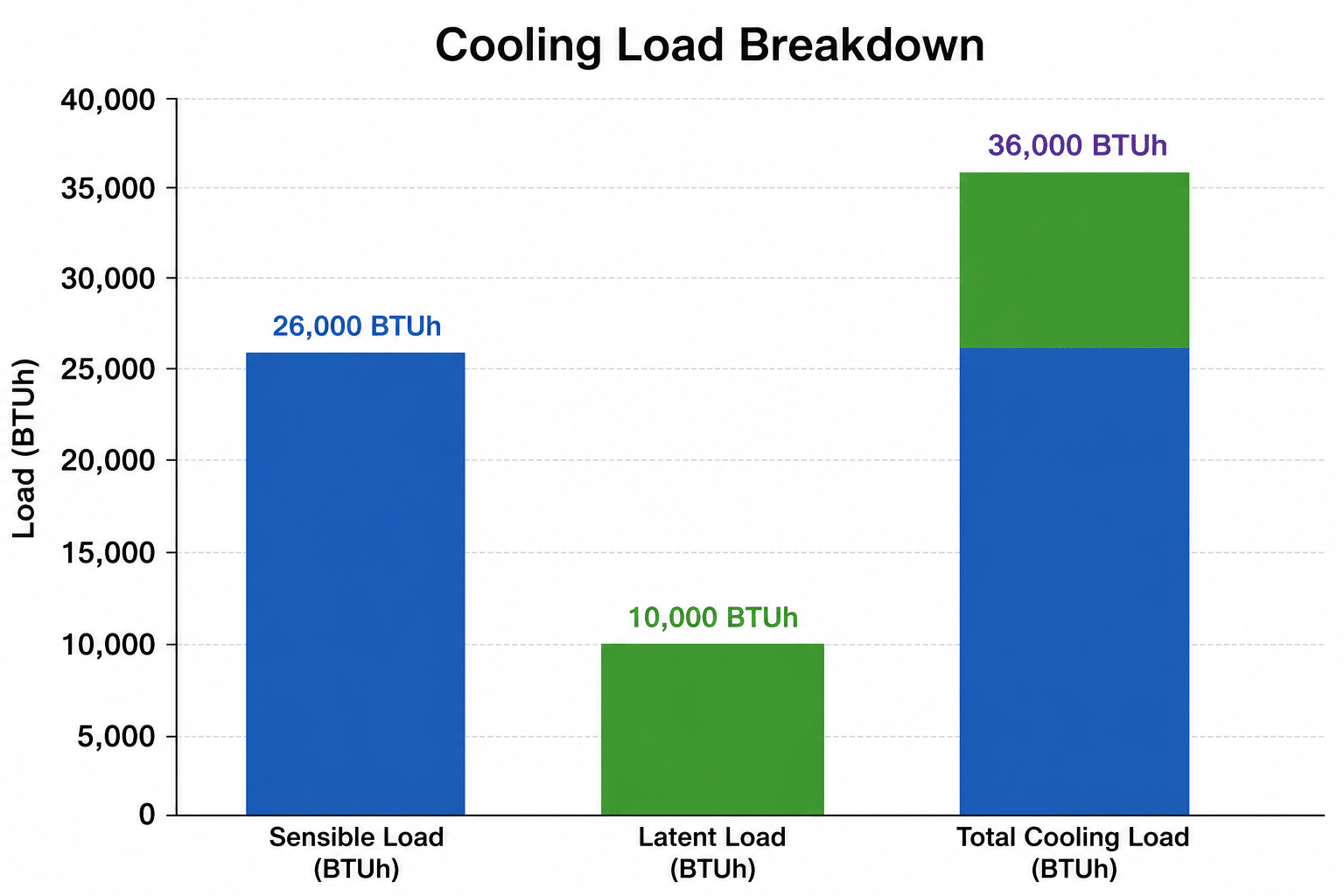
Key distinction: Sensible cooling changes air temperature. Latent cooling removes moisture. Total cooling capacity does not tell you whether the sensible and latent portions match the home.
What does an oversized HVAC humidity problem look like?
- The house feels cool but sticky
- Indoor relative humidity stays high
- The system starts and stops frequently
- Rooms feel uneven despite low thermostat readings
- Airflow feels loud or forceful
- Supply air is cold, but comfort is poor
- Musty odors return between cycles
- Condensation appears on cool surfaces or ducts
These symptoms can point toward oversizing, but they can also come from infiltration, duct leakage, ventilation imbalance, poor airflow, thermostat location, or equipment setup. A diagnosis should not stop at tonnage.
Humidity control starts with accurate sensible and latent loads.
Calculate the building loads.
Manual J estimates the home’s heating load, sensible cooling load, latent cooling load, and room-by-room requirements from the building and climate.
Match actual equipment performance.
Manual S compares those loads with manufacturer data, including total, sensible, and latent capacity at the selected design conditions.
Deliver the required airflow.
Manual D helps establish the duct sizes and distribution needed to deliver the selected system airflow to the rooms.
A system can be nominally “the right tonnage” and still be a poor match if its sensible heat ratio, airflow, or operating performance does not fit the home’s actual load profile.
Why total cooling capacity is not the whole answer.
The total cooling load is the combination of sensible and latent load. Sensible load comes from the heat that changes temperature. Latent load comes from moisture that must be removed from the air.
Equipment data also separates sensible and latent performance. That is why heat gain and heat loss alone are not enough to describe summer comfort in a humid climate.
Airflow changes the relationship. Higher airflow can increase sensible capacity while reducing moisture removal. Lower airflow can improve latent performance within the limits allowed by the equipment manufacturer.
What this means in practice: Equipment should be selected from actual performance data, not only from the nominal size printed in the model number.
How operating behavior changes.
| Operating condition | Oversized system | Properly matched system |
|---|---|---|
| Cycle length | Often short and frequent | Longer and steadier under design and part-load conditions |
| Temperature change | Rapid | More gradual and stable |
| Moisture removal | Can be limited by short runtime | More opportunity for sustained dehumidification |
| Room balance | Harder to stabilize before shutdown | More time to distribute conditioned air |
| Airflow demand | May exceed what the ducts can handle quietly | More likely to align with designed airflow |
| Comfort | Cold-and-clammy or uneven | More stable temperature and humidity |
Oversizing is not the only explanation.
High indoor humidity can remain even with correctly sized equipment when humid outdoor air enters faster than the system can remove it.
Uncontrolled outdoor air leakage
Envelope leaks, recessed lights, attic bypasses, doors, and penetrations can bring humid outdoor air into the home.
Return leaks can pull humid attic or crawlspace air into the system
Supply leaks can also depressurize the house and encourage additional outdoor-air entry.
Outdoor air must be controlled and conditioned
Airtight homes and ventilation should be evaluated together. Tight construction reduces uncontrolled leakage, but planned outdoor air still contributes to the load.
Large exhaust systems can depressurize the home
Kitchen hoods and other exhaust devices may require a separate makeup-air strategy rather than additional HVAC tonnage.
The fix depends on the cause.
Recalculate the home.
Do not automatically replace the existing unit with the same size. Use a documented load calculation and actual equipment data.
Check airflow and setup.
Blower airflow, fan mode, refrigerant charge, coil condition, thermostat configuration, and duct leakage can affect humidity performance.
Consider dedicated dehumidification.
Some homes have moisture loads that are better handled with dedicated dehumidification rather than oversizing the cooling system.
Variable-speed and multi-stage equipment can improve part-load operation, but technology cannot repair a bad load calculation, poor duct system, or excessive humid-air entry.
Oversized HVAC and humidity FAQ
Can an oversized air conditioner cause high humidity?
Yes. An oversized system may cool the house quickly and shut off before it has enough runtime to remove the expected moisture from the air. The result can be low temperature with high relative humidity.
Why does my house feel clammy even when it is cold?
The air temperature may be low while the indoor moisture level remains high. Short cycling, excessive humid-air entry, duct leakage, poor airflow, or limited latent capacity can all contribute.
What indoor humidity level is considered high?
Comfort and risk vary with temperature and building conditions, but sustained indoor relative humidity above roughly 60 percent is commonly treated as a sign that moisture control should be investigated.
Does variable-speed HVAC solve humidity problems?
Variable-speed equipment can improve part-load runtime and moisture removal, but it is not a universal fix. The load calculation, equipment selection, airflow, ducts, infiltration, and ventilation still need to be correct.
Can duct leakage cause high humidity?
Yes. Return leaks can draw humid air from attics, crawlspaces, garages, or wall cavities into the system. Supply leakage can depressurize the home and increase outdoor-air infiltration.
Should I lower the thermostat to remove humidity?
Lowering the thermostat may increase runtime temporarily, but it can overcool the house without correcting the underlying sizing, airflow, infiltration, ventilation, or equipment-performance issue.
How do I know whether my system is oversized?
Frequent short cycling and humidity complaints are clues, not proof. Compare the home’s current conditions with a room-by-room Manual J load calculation and evaluate the installed equipment using Manual S performance data.
How do I start a load-calculation project?
Use the pricing and project-start page to choose the needed Manual J, Manual S, or Manual D service and submit the available plans and construction details.
Continue through the sizing and humidity topics.
The main guide connecting the building, loads, equipment, and airflow.
Open the pillar guide →How room-by-room heating, sensible cooling, and latent cooling loads are calculated.
Explore Manual J →How actual equipment performance is matched to sensible and latent loads.
Explore Manual S →Why square-foot sizing and replacement-in-kind cannot prove correct capacity.
Compare the methods →How latent load, ventilation, and moisture removal affect equipment sizing.
Explore humid-climate design →How controlled outdoor air and infiltration affect residential loads.
Read the ventilation guide →Why large exhaust systems are a pressure problem, not an added cooling tonnage input.
Read about makeup air →What professional software calculates and what still requires project review.
Read the software guide →Choose the calculation package and submit plans and project information.
See pricing and start →Size for temperature and moisture control.
Send the plans, project location, and construction details. We will review the home and prepare the selected residential load-calculation and design documents.