
Load Calculations for Hot-Humid Climates
On the Gulf Coast and across the Deep South, the moisture load is the whole game — and it’s exactly what an oversized system fails to handle.
In a hot-humid climate — the Gulf Coast, Florida, the Deep South, and coastal and south Texas — a residential load calculation has to account for a large latent (moisture) load, not just temperature. Getting the split between sensible and latent cooling right is what separates a system that keeps a house dry and comfortable from one that’s cold, clammy, and growing mold. This is the climate where a sloppy or oversized load calculation does the most damage.
- Hot-humid covers IECC climate zones 1A, 2A, and the warm-humid edge of 3A.
- The latent (moisture) load can be a large share of the total cooling load here — and it’s invisible to a thermostat.
- Oversizing is worst in this climate: short cycles never run long enough to pull moisture out of the air.
- Representative areas: Houston, San Antonio, Tampa, Orlando, Charleston, Savannah, the Florida peninsula, the entire Gulf Coast.
What makes a hot-humid climate different?
Most of the country sizes air conditioning around temperature. On the Gulf Coast, temperature is only half the problem. The air itself is carrying enormous amounts of water, and removing that water — the latent load — takes real, sustained run time from the equipment. A system can hit the thermostat setpoint and still leave a house at 60% relative humidity: technically “cool,” actually miserable, and a perfect environment for mold and dust mites.
That’s why a load calculation done with national-average assumptions falls apart here. The design dewpoint, not just the design dry-bulb temperature, has to be right, and the sensible and latent loads have to be calculated separately. Get the latent side wrong and you size a system that controls temperature but not comfort.
Why is oversizing so dangerous in humid climates?
Everywhere, an oversized system short-cycles. In a hot-humid climate, short-cycling is specifically a humidity disaster. Moisture removal only happens while the system is actually running and the coil is cold and wet. An oversized unit satisfies the thermostat in a few minutes and shuts off — long before it has pulled meaningful water out of the air. The house gets cold fast and stays damp. Homeowners respond by dropping the thermostat further, which makes the cold-and-clammy problem worse, not better.
A right-sized system runs in longer, steadier cycles. Those long runs are what dehumidify. This is the heart of why an accurate Manual J matters more on the Gulf Coast than almost anywhere else: the margin for oversizing that a dry climate might forgive, a humid climate punishes immediately.

Hot-humid vs. other climates: what changes
| Hot-humid (Gulf Coast, FL, TX) | Cold / dry climates | |
|---|---|---|
| Load that dominates | Cooling, with a large latent share | Heating, almost entirely sensible |
| The number that matters most | Design dewpoint & latent load | Winter design dry-bulb |
| Cost of oversizing | Severe — no dehumidification, mold risk | Lower — mostly efficiency and cycling |
| Ventilation air | Must be dehumidified before it enters | Mostly just needs warming |
| Envelope priority | Stop humid air infiltration | Stop heat loss |
What we account for that a national-average calc misses
- The real design dewpoint for the specific location, not a generic humidity assumption — this drives the entire latent load.
- Latent load calculated separately from sensible, so the equipment is matched to both, not just temperature.
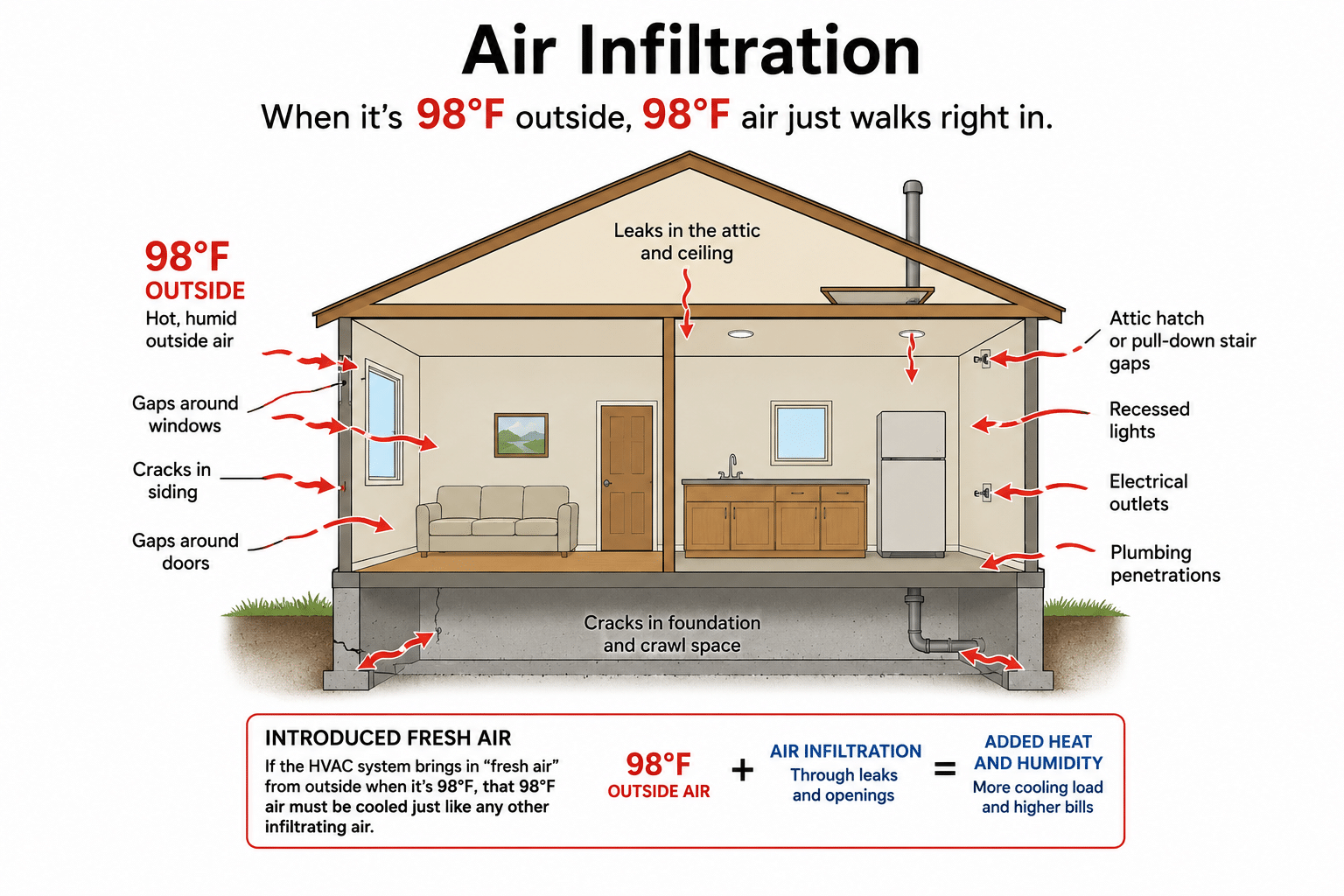
- Humid-air infiltration. In this climate, a leaky envelope doesn’t just add heat — it pumps moisture into the house all day.
- Ventilation that has to be dehumidified. Bringing in fresh air is good practice, but in a humid climate that air is a latent load the system has to handle — often best managed with dedicated dehumidification or an energy-recovery ventilator rather than dumped onto the cooling coil.
- A sanity check against the physics of a humid climate, so the final number reflects how a house actually behaves on the Gulf Coast in August.
Where we work in hot-humid climates
This is the region we know best. Our work runs across the Florida peninsula, the entire Gulf Coast, and the Deep South — the Carolina and Georgia low country, the coastal Southeast, and into Texas. Houston and San Antonio sit right in the heart of the hot-humid zone, and have been two of our busiest markets lately; the Dallas–Fort Worth area, on the warm-humid edge of the zone, is close behind. Wherever the air is heavy for most of the year, the latent load is the difference between a calculation that works and one that just looks right.
How Manual J handles it — and what comes next
A proper Manual J load calculation is where the sensible and latent loads get calculated for your specific design conditions. From there, Manual S selects equipment that can actually deliver that latent capacity — not every system that hits the tonnage handles moisture the same way — and Manual D sizes the ductwork to carry it. In a humid climate, all three steps lean on getting that first latent number right.
See the full framework on the Areas We Serve page, or start your project below.
Frequently asked questions
What makes a load calculation different in a hot-humid climate?
The latent (moisture) load. In a hot-humid climate the calculation must account for the large amount of water in the air and calculate the latent load separately from the sensible load, because removing moisture is as important as lowering temperature.
Why is an oversized air conditioner worse in a humid climate?
Because moisture is only removed while the system runs. An oversized unit cools the air quickly and shuts off before it can dehumidify, leaving the house cold and clammy at high humidity, which also encourages mold.
Which areas count as hot-humid?
IECC climate zones 1A, 2A, and the warm-humid edge of 3A, including the Gulf Coast, Florida, the Deep South, and coastal and south Texas such as Houston and San Antonio.
Do you provide load calculations in Texas and Florida?
Yes. The hot-humid region, including Houston, San Antonio, Tampa, and Orlando, is where we have the deepest experience. All work is done remotely from your plans.
Get a load calculation built for a humid climate
Sensible and latent loads calculated for your real design conditions, by someone who has done it across the Gulf Coast for decades. Send us your plans to start.
See pricing & start your load calculation →