
Manual J Load Calculations · Augusta & the Central Savannah River Area
Augusta Manual J Load Calculations
Accurate, code-ready load calculations built for Augusta's Zone 3A climate — hot humid summers, genuine winter cold, and a housing market that spans everything from historic downtown to fast-growing Columbia County.
- Climate zone: IECC Zone 3A — mixed-humid, genuine dual-season.
- Summer design temp: around 97°F with Savannah River basin humidity — substantial sensible and latent cooling load.
- Winter design temp: around 22°F — a real heating load, not a token cold snap.
- Housing stock: Augusta spans historic Summerville homes, post-war neighborhoods, and fast-growing Columbia County new construction — each requires different assumptions.
- We serve Augusta, Richmond County, Columbia County, Evans, Martinez, Grovetown, North Augusta SC, and the CSRA metro — residential primary, select light commercial.
Why Augusta's climate demands careful sizing on both ends
Augusta sits squarely in IECC Climate Zone 3A alongside Atlanta and Birmingham, sharing the same zone designation but with its own distinct character. Sitting in the Savannah River basin gives Augusta a humidity signature that rivals the coast, while its inland position means genuine winter cold:
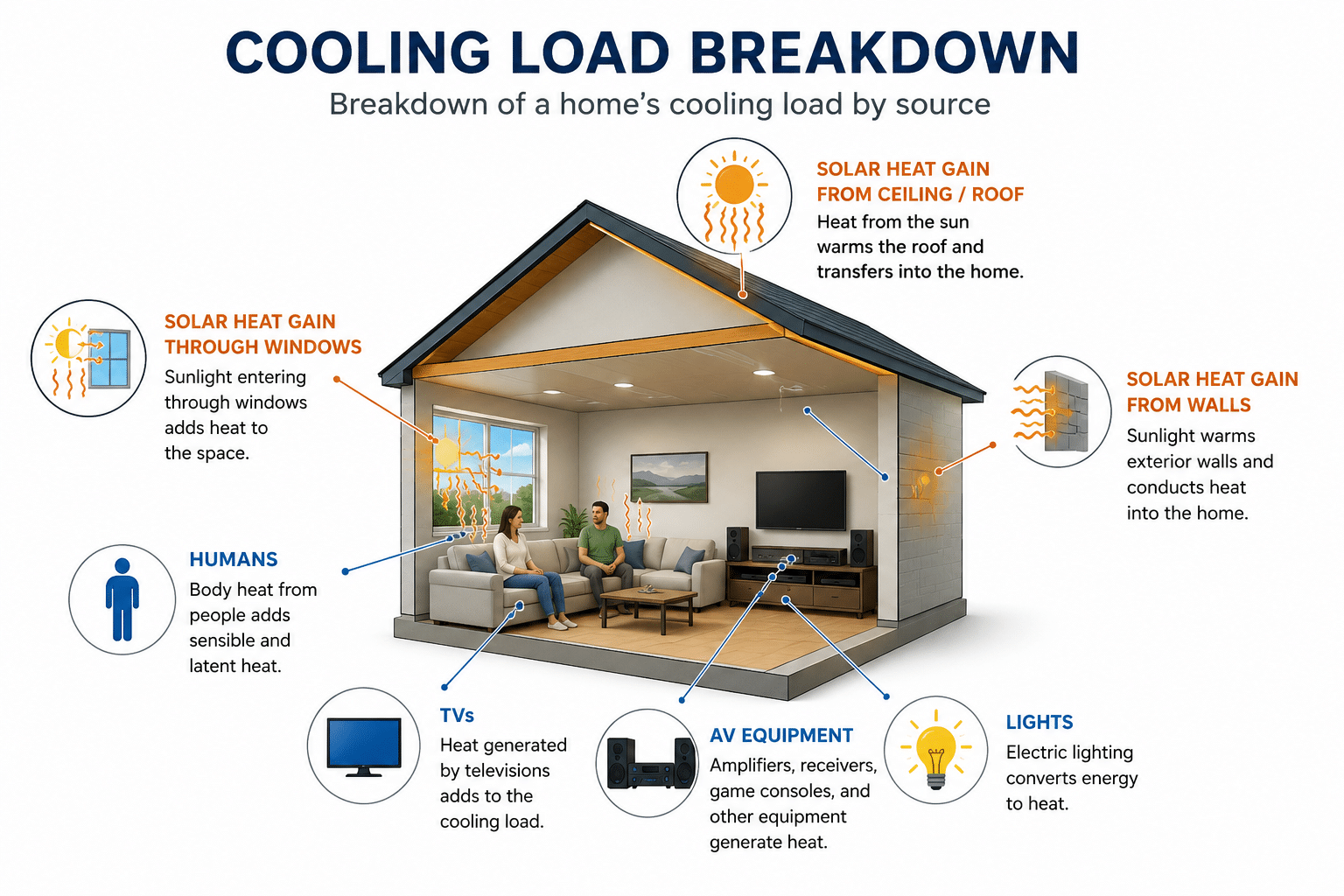
- The summer load is large and moisture-driven. At 97°F in the Savannah River basin, Augusta homes carry both a high sensible cooling load and a real latent load. The humidity doesn't let up until fall, and equipment that short-cycles — the classic sign of oversizing — leaves a home cool at the thermostat but muggy throughout.
- Winter is not a secondary concern. Augusta's 22°F winter design temperature is the same as Atlanta's — real heating load territory. The Georgia State Minimum Energy Code requires adequate insulation and envelope performance for a reason, and a Manual J confirms whether the plans actually meet it.
- Housing stock varies dramatically. Historic Summerville homes have different envelope characteristics than 1960s ranch stock in Harrisburg, which differs again from new construction in Grovetown or Evans. A square-footage estimate ignores all of that. A real Manual J works from the actual plans.
- Columbia County is one of Georgia's fastest-growing counties. New construction in Evans, Grovetown, and Martinez runs on permit timelines — builders need accurate, fast load calculations that can withstand plan review.
Augusta design specifications at a glance
| Augusta design specification | Technical requirement |
|---|---|
| IECC climate zone | 3A (Mixed-Humid) |
| Summer design temp | ~97°F with Savannah River basin humidity |
| Winter design temp | ~22°F — real heating load |
| Primary code | Georgia State Minimum Standard Energy Code (IECC-based) / SC Energy Code for North Augusta |
| Key challenge | High latent summer load + real winter + diverse housing stock from historic to fast-growth new construction |
What goes into an Augusta load calculation
We run a full room-by-room ACCA Manual J using the Central Savannah River Area's actual design conditions. Every factor is taken from the plans — nothing is assumed:
| Factor | Why it matters in Augusta |
|---|---|
| Latent (moisture) cooling load | Savannah River basin humidity makes Augusta's latent load significant — calculated separately from sensible cooling to prevent short-cycling and humidity problems. |
| Winter heating load | 22°F design temperature means every wall, window, ceiling, and foundation detail matters. Historic homes often have insulation levels far below current code minimums. |
| Actual envelope assemblies | Augusta's housing stock range — from 1920s Summerville to new Columbia County construction — means we read the actual plans, not apply a default insulation value. |
| Window orientation & solar gain | Summer sun on south and west glass is a top cooling driver — each glazing counted by direction and spec, not averaged across the footprint. |
| Infiltration | Older Augusta housing stock can have high infiltration rates that add significantly to both the summer latent load and the winter heating load. |
The result is the honest heating, cooling, and dehumidification load your equipment should be sized to — the foundation for selecting the right equipment and designing ducts that deliver conditioned air to every room.

Who we work with in the Augusta area
We provide Augusta and CSRA load calculations for builders, HVAC contractors, architects, and homeowners across both sides of the Savannah River. Houses are our specialty — we also take on select light commercial such as small offices and recreation centers. We serve Augusta, Evans, Martinez, Grovetown, Harlem, Thomson, Waynesboro, and North Augusta and Aiken SC across the state line — and we work nationwide.
How Augusta fits the bigger picture
An Augusta load calculation is one application of the same ACCA methodology we run everywhere — the climate inputs change, the rigor doesn't. For the full method, start with our Manual J load calculation overview, then see how heat gain and heat loss move through a home across both seasons. Working in nearby Zone 3A markets? See our Atlanta and Columbia SC pages, or browse our full areas served.
Frequently asked questions
What climate zone is Augusta in for HVAC load calculations?
Augusta is in IECC Climate Zone 3A, classified as mixed-humid. It is a genuine dual-season climate with a summer design temperature around 97°F and a winter design temperature around 22°F. The Savannah River basin adds a humidity signature that makes the latent cooling load significant, alongside the real winter heating load.
How is Augusta different from Atlanta for HVAC sizing?
Both cities are in IECC Zone 3A with similar design temperatures — Atlanta at 92°F summer and 22°F winter, Augusta at 97°F summer and 22°F winter. Augusta's hotter summer and its Savannah River basin humidity make the cooling and latent load slightly more demanding. Augusta also has a wider range of housing stock, from pre-war historic homes in Summerville to fast-growing new construction across Columbia County.
Does Augusta's older housing stock require a different approach to load calculations?
Yes. Historic homes in Summerville, Harrisburg, and other established Augusta neighborhoods often have insulation levels, window specifications, and infiltration rates that differ significantly from current code minimums and from new construction. A Manual J reads the actual plans and uses real assembly values — it does not apply default assumptions that are only accurate for new builds.
Why does humidity matter so much for Augusta HVAC sizing?
Augusta sits in the Savannah River basin, which creates elevated humidity through much of the summer. The latent cooling load — moisture the system must remove — is calculated separately from sensible cooling. An oversized system that short-cycles brings the temperature down quickly but never runs long enough to remove humidity, leaving the home feeling damp at the set temperature.
Do you serve North Augusta and the South Carolina side of the CSRA?
Yes. We serve the full Central Savannah River Area including North Augusta, Aiken, Beech Island, and surrounding South Carolina communities, in addition to Augusta, Richmond County, and Columbia County on the Georgia side. We work nationwide and handle both Georgia and South Carolina code requirements.
An accurate, code-ready ACCA Manual J using CSRA design conditions — sized for Augusta's 97°F summer humidity load and the 22°F winter that older housing stock handles harder than new construction.
See pricing & start your load calculation →