
Atlanta Manual J Load Calculations
Accurate, code-ready load calculations built for metro Atlanta’s Zone 3A climate — the textbook warm-humid Southeast, where elevation, tree cover, and a sprawling mix of housing all shape the load.
An Atlanta Manual J load calculation determines a home’s true heating and cooling loads using metro Georgia’s actual design conditions — IECC Climate Zone 3A, warm and humid. Atlanta is so representative of this climate that ASHRAE uses it as the example city for Zone 3A design data. It’s a balanced two-season market: humid ~92°F summers that demand real cooling and dehumidification, and ~22°F winter mornings that create a genuine heating load. What shapes an Atlanta calculation beyond the numbers is the metro itself — high elevation for the Southeast, heavy tree canopy, and housing that ranges from in-town bungalows to far-flung new construction.
- Climate zone: IECC Zone 3A — warm-humid; Atlanta is ASHRAE’s reference city for the zone.
- Summer design temp: around 92°F with high humidity.
- Winter design temp: around 22°F — a real heating load.
- Local factors: elevation around 1,000+ feet and heavy tree canopy affect solar gain and shading room by room.
- We serve Atlanta, Marietta, Alpharetta, Roswell, Sandy Springs, Decatur, Kennesaw, and metro Georgia — residential plus select light commercial.
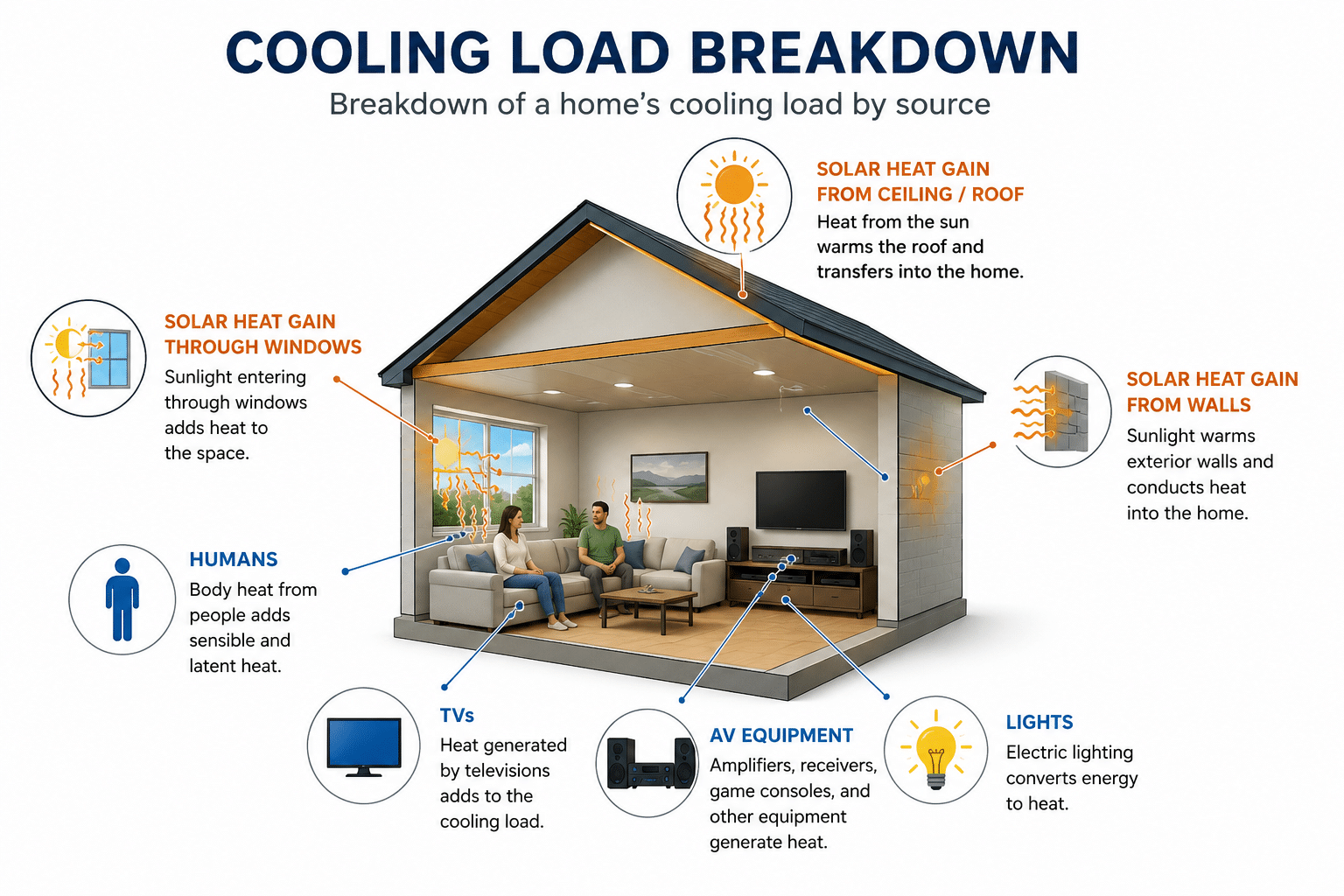
Why metro Atlanta sizing takes local judgment
Atlanta sits in IECC Climate Zone 3A — the same warm-humid zone as much of the inland Southeast — but the metro’s scale and character give it a distinct sizing profile:
- It’s a balanced two-season climate. Humid ~92°F summers need real cooling and dehumidification; ~22°F winters create a genuine heating load. Both sides have to be sized, and the right cooling and heating capacities are often different numbers.
- Elevation and tree canopy matter. Atlanta is high for the Southeast, and its famous tree cover means shading varies dramatically house to house. A heavily shaded north-facing home and a sun-exposed west-facing one in the same neighborhood can have very different loads — which is why a room-by-room Manual J beats any rule of thumb here.
- The housing stock is enormous and varied. From early-1900s in-town homes to sprawling new construction in the outer suburbs, Atlanta’s building stock spans a century of envelopes and assemblies. Each needs its own honest inputs, not a one-size estimate.
- Oversizing still backfires. An oversized system short-cycles, misses humidity on muggy summer days, and swings the temperature — the opposite of the steady comfort right-sizing delivers.
The Atlanta reality: “Zone 3A” sets the design temperatures, but two homes a block apart can need different equipment because of shading, orientation, age, and elevation. A real load calculation captures that house-by-house — a square-footage rule of thumb never will.
Atlanta design specifications at a glance
| Atlanta design specification | Technical requirement |
|---|---|
| IECC climate zone | 3A (Mixed-Humid) |
| Summer design temp | ~92°F |
| Winter design temp | ~22°F |
| Indoor design humidity | 50% RH (standard) |
| Primary code | Georgia State Minimum Standard Energy Code |
What goes into an Atlanta load calculation
We run a full room-by-room ACCA Manual J using metro Atlanta’s design conditions, accounting for:
| Factor | Why it matters in Atlanta |
|---|---|
| Summer & winter design temps | Zone 3A’s balanced range — ~92°F summer, ~22°F winter — so both loads are sized to real local conditions. |
| Latent (moisture) load | Humid Southeast summers carry a real latent load, calculated separately from sensible cooling. |
| Orientation, shading & SHGC | Tree canopy and exposure make solar gain highly house-specific; each glazing counted by direction, shading, and glass spec. |
| Building age & envelope | From in-town historic homes to new suburban construction, the actual assemblies are checked against Zone 3A baselines (around R-20 wall, R-30 ceiling). |
| Infiltration & ventilation | Outdoor air entering the home is a load in both seasons and must be conditioned. |
The result is the honest heating and cooling load your equipment should be built around — the foundation for selecting the right equipment and designing ducts that deliver it to every room.
Who we work with in metro Atlanta
We provide Atlanta and metro Georgia load calculations for builders, HVAC contractors, architects, and homeowners — anyone who needs a clean, defensible number for permitting, equipment selection, or a comfort problem that won’t go away. Houses are our specialty; we also take on select light commercial such as small offices and recreation centers. We serve Atlanta, Marietta, Alpharetta, Roswell, Sandy Springs, Decatur, Johns Creek, Kennesaw, Smyrna, Athens, Douglasville, and the surrounding metro — and we work nationwide.
How Atlanta fits the bigger picture
An Atlanta load calculation is one application of the same ACCA methodology we run everywhere — the climate inputs change, the rigor doesn’t. For the full method, start with our Manual J load calculation overview, or see how heat gain and heat loss move through a home across both seasons. Working another Georgia market? We cover the whole country from the same playbook.
Frequently asked questions
What climate zone is Atlanta in for HVAC load calculations?
Atlanta is in IECC Climate Zone 3A, classified as warm-humid, and is in fact the city ASHRAE uses as its reference example for Zone 3A. It is a balanced climate with a humid summer cooling load around a 92 degree design temperature and a real winter heating load around a 22 degree design temperature.
How is Atlanta sizing different from other Zone 3A cities?
The design temperatures are similar across Zone 3A, but Atlanta’s high elevation for the Southeast, heavy tree canopy, and very mixed housing stock make shading and orientation highly house-specific. That is why a room-by-room Manual J, rather than a rule of thumb, is especially important here.
Does Atlanta need to size for heating as well as cooling?
Yes. Atlanta winters drop to a design temperature around 22 degrees Fahrenheit, so the heating load is real. Both the heating and cooling sides must be sized properly in this balanced two-season climate.
Do you serve the whole Atlanta metro?
Yes. We provide residential load calculations across Atlanta, Marietta, Alpharetta, Roswell, Sandy Springs, Decatur, Kennesaw, and metro Georgia, plus select light commercial such as small offices and recreation centers, and we work nationwide.
Get an Atlanta load calculation built for Zone 3A
An accurate, code-ready ACCA Manual J using metro Atlanta’s real design conditions, sized house-by-house for the humid summer and the cold winter — for builders, contractors, and homeowners across the metro.
See pricing & start your load calculation →Ready to Get Started?
Our Manual J & Manual D Load Calculation Design Services are provided to Architects, Homeowners, and HVAC contractors in the metro-Atlanta and surrounding area of Georgia utilizing ACCA-recognized HVAC design Software. Georgia State Building Code-compliant calculations that pass inspection the first time.
No delays. No rejections. No excuses. We serve all Georgia counties.