
Las Vegas Manual J Load Calculations
Accurate, code-ready load calculations built for the Las Vegas desert — extreme dry heat, big day-to-night swings, and a sizing problem that’s the mirror image of a humid climate.
A Las Vegas Manual J load calculation determines a home’s true heating and cooling loads using the Mojave Desert’s actual design conditions — IECC Climate Zone 3B, a hot, dry climate. Vegas is the opposite of a Gulf Coast city: the air is bone-dry, so the moisture (latent) load that dominates Miami or Houston barely registers here. Instead the whole game is sensible heat — extreme summer temperatures, intense solar gain, and a big drop to cold desert nights. Sizing for that dry heat without overshooting is what a real load calculation gets right.
- Climate zone: IECC Zone 3B — hot, dry desert.
- Design conditions: summer design temperature commonly in the 105–108°F range with very low humidity, dropping to cold desert nights and a real winter heating load.
- Latent load is minor: dry air means moisture removal is a small part of the job — the reverse of a humid climate.
- Sensible heat & solar gain dominate: the cooling load is driven by temperature and sun, not humidity.
- We serve Las Vegas, Henderson, North Las Vegas, Boulder City, Summerlin, Pahrump, and Mesquite — residential plus select light commercial.
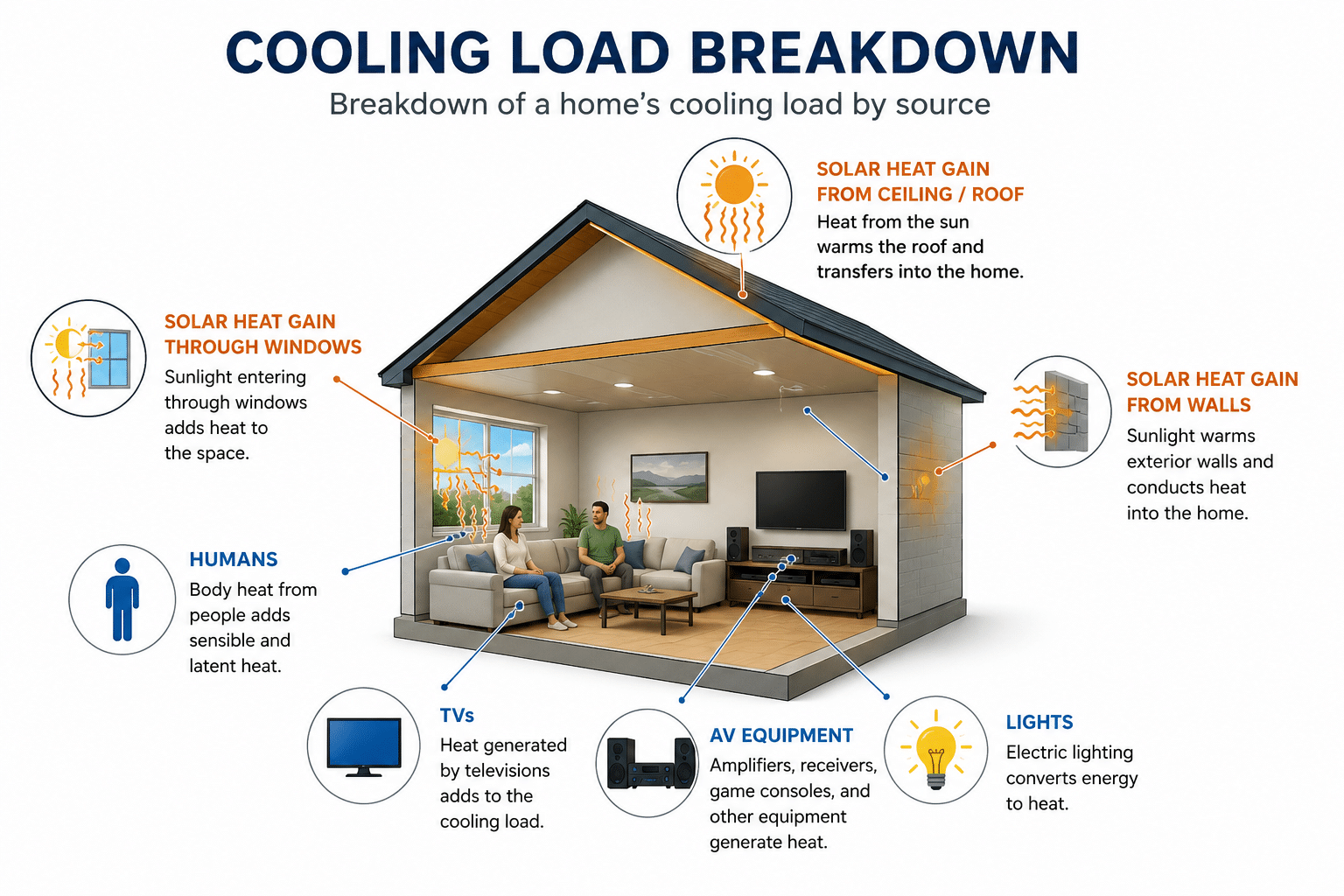
Why Las Vegas sizing is the opposite of a humid climate
Las Vegas sits in IECC Climate Zone 3B — hot and dry. If you only know HVAC sizing from the Gulf Coast or the Southeast, the desert flips your instincts:
- The latent load nearly disappears. In Miami or Houston, pulling moisture out of the air is half the battle. In Vegas the air is dry, so the air conditioner spends almost all its capacity on sensible cooling — lowering temperature, not wringing out water. Sizing built around humid-climate assumptions gets this wrong.
- The dry heat is extreme. Summer design temperatures sit around 105–108°F. That’s a massive sensible cooling load, and it’s relentless through the afternoon — the system has to be sized to hold the house on the worst day, not an average one.
- Day-to-night swings are large. The desert sheds heat fast after sundown. The calculation has to capture peak afternoon load without assuming the home bakes all night the way a humid climate does.
- Winter is real. Vegas nights get genuinely cold and the winter heating load matters — and in the higher elevations of Clark County (above 4,000 feet) the climate shifts colder still, into Zone 5B. Elevation changes the answer, and it’s easy to miss.
The desert trap: because there’s little humidity to remove, an oversized system in Vegas just short-cycles on temperature — blasting cold, clicking off, and swinging the house warm again. You don’t get the “clammy” penalty of a humid climate, but you do get uneven temperatures, higher bills, and early wear. Right-sizing to the real sensible load is the fix.
What goes into a Las Vegas load calculation
We run a full room-by-room ACCA Manual J using the Las Vegas valley’s design conditions, not a national average. That means accounting for:
| Factor | Why it matters in Las Vegas |
|---|---|
| Summer & winter design temps | Zone 3B’s extreme dry-summer peak and cold-night winter, sized to real local conditions and the correct elevation. |
| Sensible cooling load | The dominant load here — driven by temperature and solar gain, not moisture. |
| Window orientation & SHGC | Intense desert sun makes solar gain through glass a top driver; each glazing counted by direction and glass spec. |
| Insulation & envelope | Zone 3B baselines checked against the actual assemblies — the envelope is the home’s defense against the heat. |
| Elevation | Higher-elevation Clark County locations shift colder (toward Zone 5B), changing both the load and the equipment’s capacity. |
The result is the honest cooling and heating load your equipment should be built around — the foundation for selecting the right equipment and designing ducts that deliver it to every room.
Who we work with in Las Vegas
We provide Las Vegas and Clark County load calculations for builders, HVAC contractors, architects, and homeowners — anyone who needs a clean, defensible number for permitting, equipment selection, or a comfort problem that won’t go away. Houses are our specialty; we also take on select light commercial such as small offices and recreation centers. We cover Las Vegas, Henderson, North Las Vegas, Boulder City, Summerlin, Pahrump, Mesquite, and the surrounding valley, and we work nationwide.
How Las Vegas fits the bigger picture
A Las Vegas load calculation is one application of the same ACCA methodology we run everywhere — the climate inputs change, the rigor doesn’t. For the full method, start with our Manual J load calculation overview, or see how heat gain and heat loss move through a home. The desert is a useful contrast: it shows how much the climate drives the answer, which is exactly why a generic, one-size estimate fails. We cover the whole country from the same playbook.
Frequently asked questions
What climate zone is Las Vegas in for HVAC load calculations?
Las Vegas is in IECC Climate Zone 3B, classified as hot and dry. The cooling load is driven by extreme dry-summer heat and solar gain rather than humidity, and higher-elevation parts of Clark County shift into the colder Zone 5B.
Does humidity matter for Las Vegas HVAC sizing?
Much less than in a humid climate. Because desert air is dry, the latent (moisture) load is small, so the air conditioner spends almost all its capacity on sensible cooling. This is the opposite of sizing for a Gulf Coast or Southeast home.
Can I use a square-footage rule of thumb in Las Vegas?
No. Rules of thumb ignore solar orientation, envelope assemblies, and the extreme design temperature, and they often carry humid-climate assumptions that do not apply in the desert. They typically oversize the system, which causes short-cycling and uneven temperatures.
Do you serve all of the Las Vegas valley?
Yes. We provide residential load calculations across Las Vegas, Henderson, North Las Vegas, and Clark County, plus select light commercial such as small offices and recreation centers, and we work nationwide.
Get a Las Vegas load calculation built for the desert
An accurate, code-ready ACCA Manual J using the Las Vegas valley’s real Zone 3B design conditions — for builders, contractors, and homeowners across Clark County.
See pricing & start your load calculation →