
Shreveport Manual J Load Calculations
Shreveport sits at the corner where Louisiana’s Gulf humidity runs headlong into Texas heat and Arkansas winters. It is a two-season market that the Gulf Coast never has to deal with — genuinely hot, genuinely humid summers, and winters that drop cold enough to make heating a real part of the sizing conversation. A square-footage estimate handles neither side correctly.
A proper Manual J load calculation determines the actual heating and cooling loads for a Shreveport home — using Red River valley design conditions, not a Gulf Coast assumption and not a Texas assumption. The result is a load number that works for both seasons and gives the humidity its due weight in the cooling calculation.
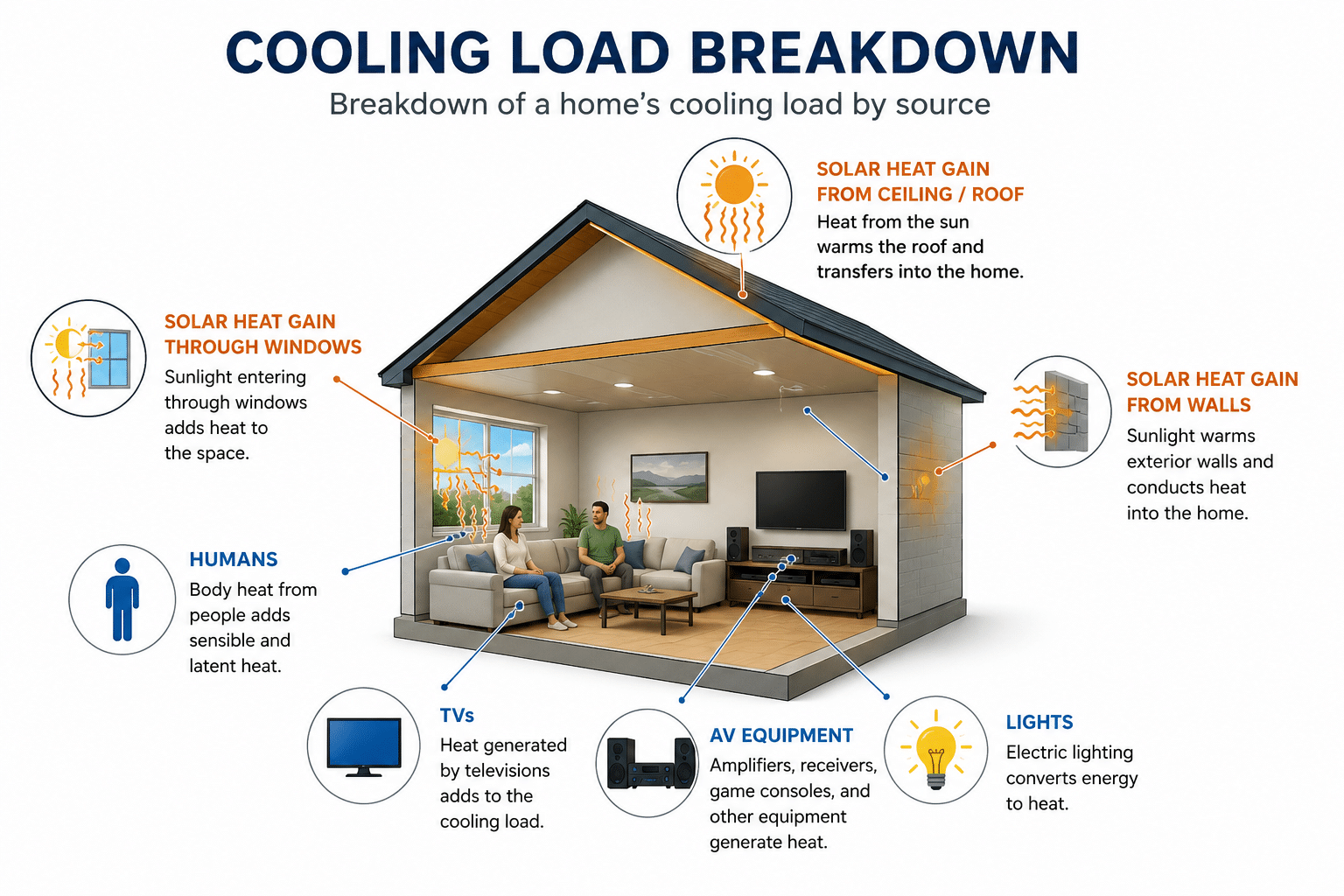
Shreveport’s summer cooling load arrives through multiple paths simultaneously — solar gain, conduction, infiltration of hot humid air, and internal gains. A Manual J accounts for each one separately, room by room.
Manual J
Room-by-room load calculation using Shreveport’s actual design conditions — both the summer cooling load and the real winter heating load.
Learn about Manual J →Manual S
Equipment matched to real manufacturer performance at your design conditions — total, sensible, and latent capacity all verified separately.
Learn about Manual S →Manual D
Duct design sized to deliver the calculated airflow to every room — built from your floor plans, not a field guess.
Learn about Manual D →Why Shreveport is a two-season sizing problem

Shreveport occupies a climate position that demands respect for both seasons. Summer design temperatures push into the mid-to-upper 90s with Red River valley humidity that keeps the latent load high from May through September. But winter drops the design temperature to around 22°F — cold enough that heating is a genuine part of the equation, not an afterthought.
That two-sided demand is what sets Shreveport apart from the deeper Gulf markets. New Orleans and Houston are cooling-dominated; you can almost ignore the heating side. Shreveport cannot. A heat pump sized only for the summer cooling load may not have adequate heating capacity when January delivers a hard freeze. A gas furnace sized only for the coldest morning is probably oversized for the cooling coil it shares.
The humidity is a year-round variable here too. Unlike drier climates where humidity management only matters in summer, Shreveport’s proximity to the Gulf keeps relative humidity elevated into the shoulder seasons. The latent component of the cooling load is real, and it is exactly what a rule-of-thumb estimate ignores. See our overview of hot and humid climate load calculations for how moisture changes the sizing math.
The Shreveport sizing challenge: you are sizing for a humid mid-to-upper-90s summer and a 22°F winter in the same calculation, with a meaningful latent load on the cooling side. Both seasons have to be right, and the humidity has to be calculated — not estimated. That is what a Manual J delivers and a square-footage guess cannot.
What goes into a Shreveport load calculation
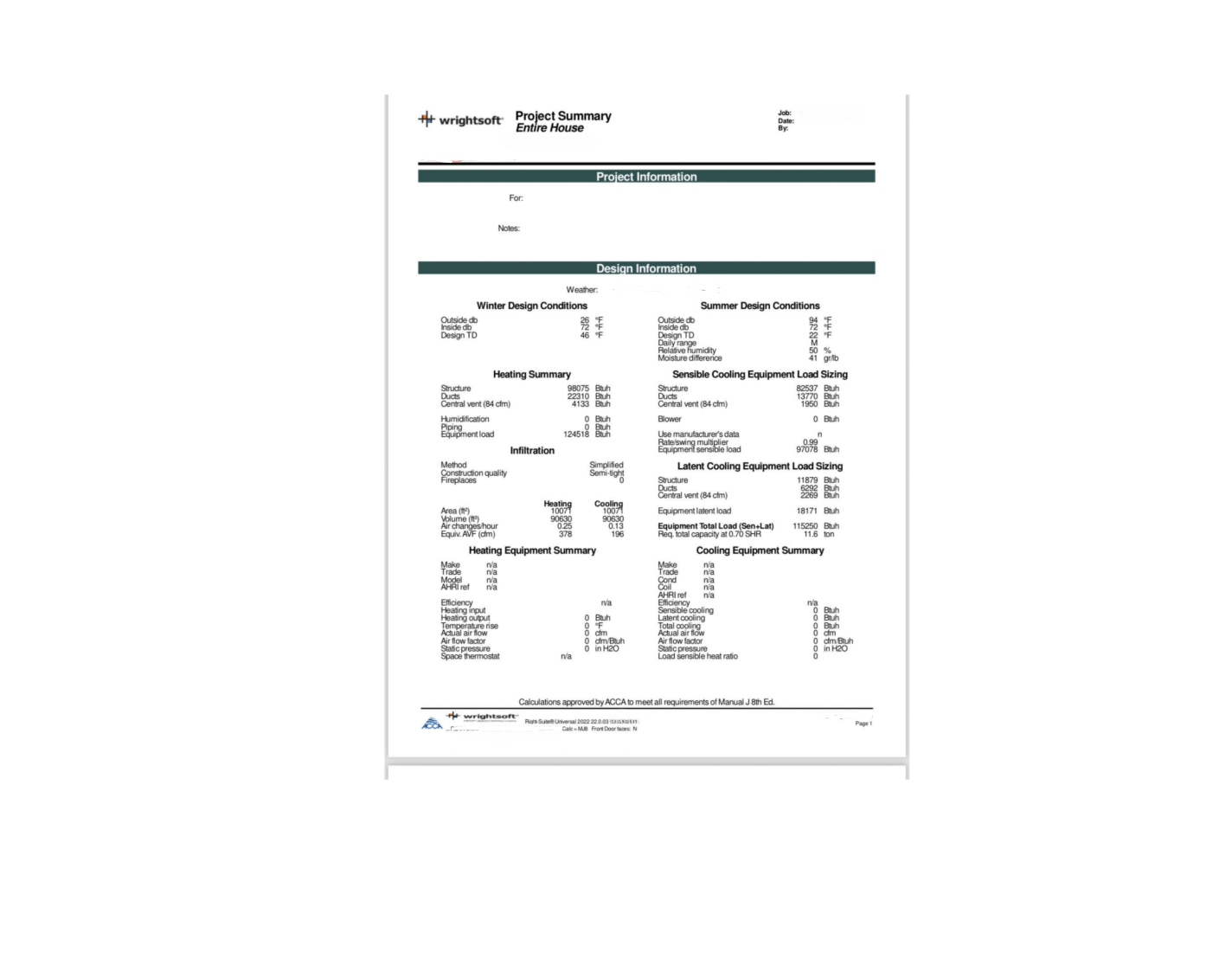
We run a full room-by-room ACCA Manual J in WrightSoft Right-Suite Universal using Shreveport’s actual design conditions — not Gulf Coast numbers, not Texas numbers:
| Factor | Why it matters in Shreveport |
|---|---|
| Summer design temp | Mid-to-upper 90s°F — the sensible cooling load is large and drives equipment sizing. |
| Winter design temp | Around 22°F — a real heating load that must be sized alongside the cooling load, not ignored. |
| Latent (moisture) load | Calculated separately from sensible cooling — Red River valley humidity means moisture removal matters on both sides of the summer peak. |
| Solar gain through glazing | Intense summer sun makes window orientation and SHGC a top cooling driver; each glazing counted separately. |
| Insulation & envelope | The envelope has to perform in both extreme heat and genuine cold — both sides of the calculation depend on it. |
| Infiltration & ventilation | Hot, humid outdoor air entering the home is a continuous latent and sensible load in summer; cold dry air in winter. |
Heat pumps in Shreveport — the balance point question

Heat pumps are increasingly common in Louisiana markets, and Shreveport’s winter design temperature of around 22°F raises a question that warmer climates never have to answer: does the heat pump have enough heating capacity when temperatures drop?
Most heat pumps lose capacity as outdoor temperature falls. At 22°F, a unit sized only for the summer cooling load may be delivering 60% of its rated heating output — which may or may not be enough to meet the calculated heating load. The Manual S equipment selection process checks the balance point — the outdoor temperature at which the heat pump’s output meets the home’s heating demand — so there are no surprises in January.
For variable-speed systems, this analysis is even more important. A modulating system that performs beautifully in mild weather may still need its cold-climate heating capacity verified against Shreveport’s winter design conditions before equipment selection is complete.
The housing stock across greater Shreveport
The Shreveport-Bossier City metro has a wide range of housing construction — older brick ranches and craftsman homes in the established South Highlands and Garden neighborhoods, post-war construction throughout Bossier City, and newer suburban development spreading south into Keithville and west toward Greenwood. Each presents a different load profile.
Older construction often has minimal attic insulation, single-pane windows, and ductwork sized for equipment that no longer exists. These homes routinely have loads significantly higher than their square footage suggests — particularly the infiltration load, which compounds the latent problem in a humid climate. See our overview of airtight homes and ventilation for how building tightness affects the load calculation.
Newer suburban construction is better built but often features open floor plans, high ceilings, and west-facing glass that drives the afternoon cooling load well above what builders expect. In both cases, a Manual J built from actual construction documents is the only way to size correctly.
Areas we serve around Shreveport
We provide residential Manual J load calculations, Manual S equipment selection, and Manual D duct design across the Shreveport-Bossier City metro and northwest Louisiana — remotely, with no site visit required.
We also serve Baton Rouge and New Orleans across Louisiana, and work nationwide. Every project uses the same ACCA methodology — the climate inputs change, the rigor does not.
Who we work with in the Shreveport area
HVAC contractors use our calculations to pull permits, select equipment with confidence, and deliver comfort that holds up through both Shreveport’s humid summers and its cold snaps. A permit-ready Manual J, S, and D package means fewer questions at the inspection desk and a defensible record if the homeowner has questions later.
Builders and architects need the load data before mechanical rough-in and equipment specs are committed to. We coordinate with the mechanical drawings so the system that gets installed matches what the house actually requires.
Homeowners replacing a system or investigating a comfort problem get an independent answer before a contractor quotes equipment. Knowing the right size before the conversation starts — including the heat pump balance point question — is worth more than the cost of the calculation.
Frequently asked questions
Yes. Louisiana’s State Uniform Construction Code requires a Manual J load calculation for new construction and HVAC replacements requiring a permit. The calculation must use actual design conditions and construction details for the specific project — not a rule-of-thumb estimate. We deliver permit-ready reports built to meet that standard. Your contractor or building department will confirm the local submittal requirements for Caddo and Bossier Parish.
Manual J load calculations start at $0.14 per square foot with a $350 minimum. Full Manual J, S, and D design packages start at $990. See our pricing page for the complete rate schedule including add-ons for ERV selection and duct design.
Yes. Unlike deeper Gulf markets, Shreveport has a real winter heating load with a design temperature around 22°F. Both the cooling and heating sides must be calculated and both must drive the equipment selection. A system sized only for the summer load may underperform in January.
Yes, and many Shreveport homes use them. But heat pump sizing requires a balance point analysis against the 22°F winter design temperature to confirm the unit has adequate heating capacity when temperatures drop. Manual S equipment selection covers this as part of the standard process.
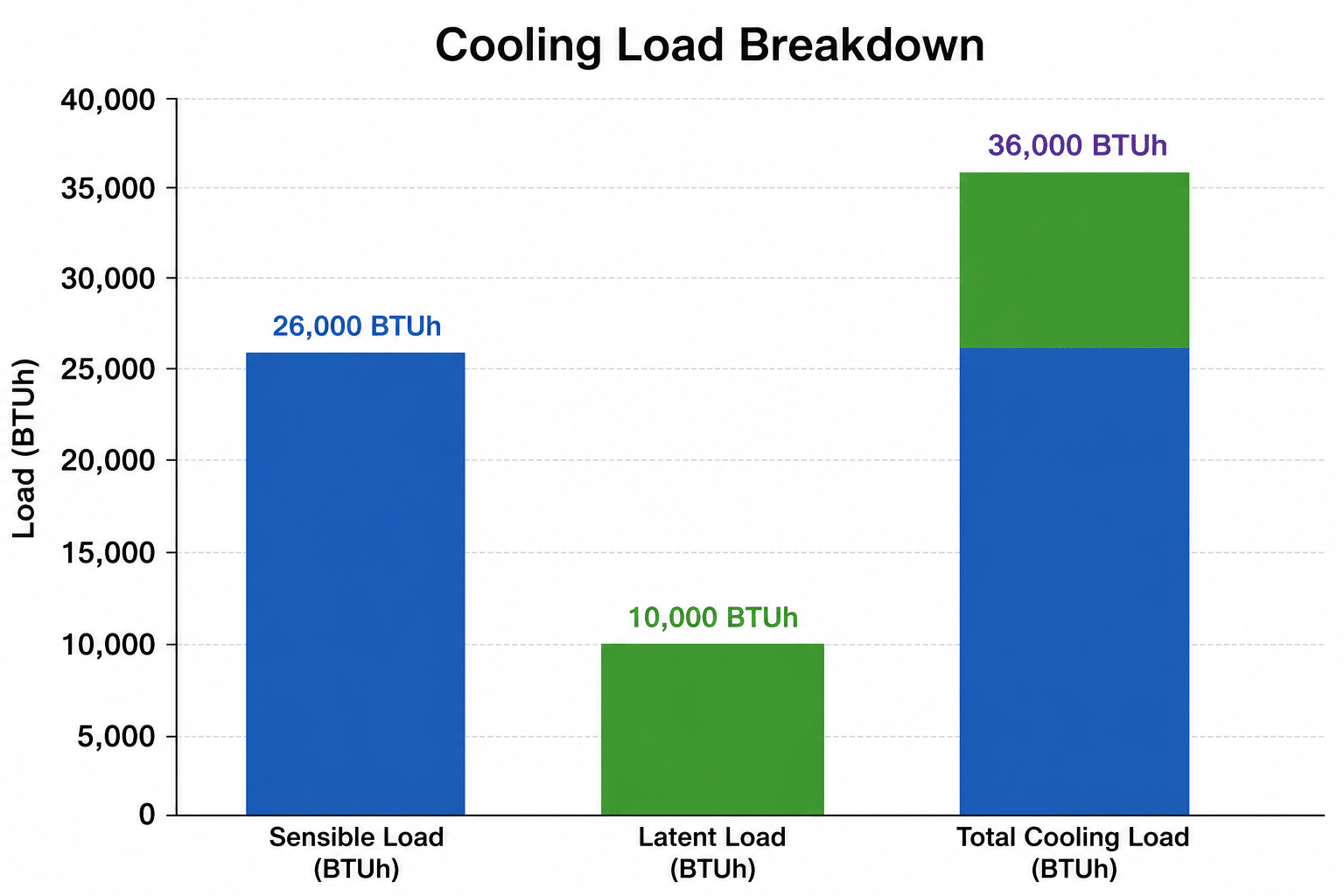
Shreveport’s Red River valley location keeps humidity elevated through the summer and into the shoulder seasons. The cooling load has both a sensible (temperature) component and a latent (moisture) component. A proper Manual J calculates both separately so the selected equipment handles dehumidification as well as cooling — not just total BTUs.
Most residential projects are completed within 24 to 48 hours of receiving your plans and project information. We work remotely — you send floor plans, window specs, insulation details, and orientation, we model the home in WrightSoft and return a permit-ready PDF report. No site visit required.
Manual J calculates the room-by-room heating and cooling loads. Manual S selects equipment whose real published performance at your design conditions matches those loads — checking total, sensible, and latent capacity. Manual D designs the duct system to deliver the calculated airflow to every room. The three are a chain — each depends on the one before it. See our full overview of the design chain.
Get a Shreveport load calculation built for northwest Louisiana.
Accurate, permit-ready Manual J, S, and D reports using real Shreveport design conditions — sized for both the humid summer and the cold winter.
See pricing and get started Send your plans