
Manual S Residential Equipment Selection: What the PDF Actually Shows
Nameplate tonnage is a rating at standard test conditions. Your house doesn’t operate at standard test conditions. Manual S is what connects the label to the reality.
What AHRI ratings don’t tell you
Every air conditioner has an AHRI-certified capacity rating. A “3-ton” unit is rated at 36,000 BTU/hr at standard conditions: 95°F outdoor dry-bulb, 80°F indoor dry-bulb, 67°F indoor wet-bulb. That rating is real — at those specific conditions. Change the conditions and the capacity changes.
| Outdoor temp | Typical capacity vs. AHRI rating | Impact |
|---|---|---|
| 85°F | +5–8% above nameplate | System overcools, short-cycles |
| 95°F (AHRI standard) | 100% — nameplate rating | Exactly as rated |
| 100°F | –8–12% below nameplate | May struggle on hottest days |
| 105°F | –15–20% below nameplate | Will fall short in extreme heat climates |
Manual S requires checking manufacturer expanded performance data at your actual design conditions — not AHRI standard. A system rated at 36,000 BTU/hr at 95°F might deliver 32,500 BTU/hr at 100°F. That 10% drop can be the difference between holding setpoint on the hottest afternoon and running continuously without catching up.
The sensible heat ratio check
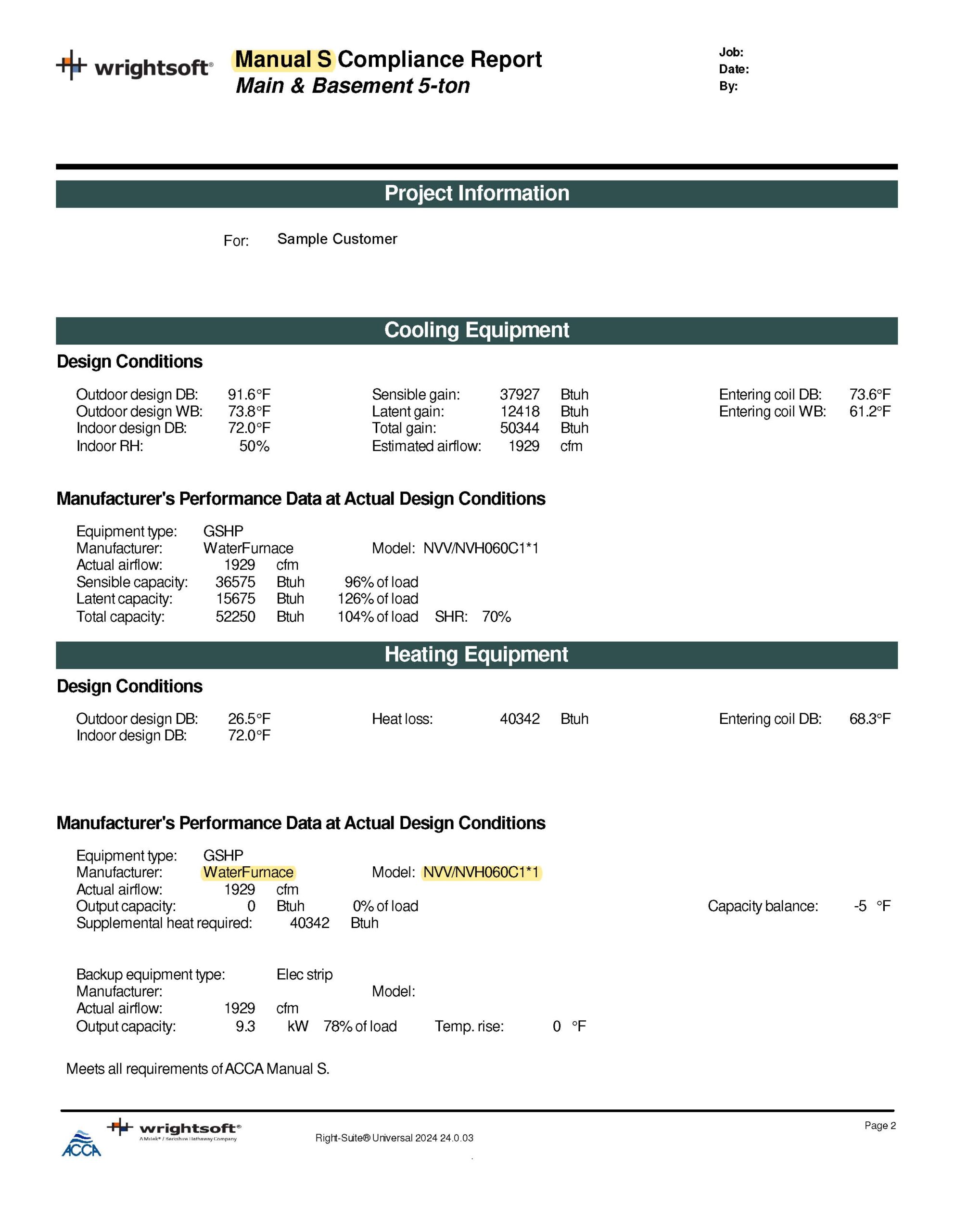
Total cooling capacity is one number. The split between sensible capacity (temperature reduction) and latent capacity (moisture removal) is another — and in humid climates, the latent side determines whether the house feels comfortable or cool but clammy.
Every cooling unit has a sensible heat ratio (SHR) — the fraction of total cooling going toward sensible. SHR varies with conditions. Manual S checks sensible and latent capacity separately against the Manual J loads. If sensible is adequate but latent is short, the house runs at temperature but stays humid. That’s a common complaint pattern that gets misdiagnosed as a refrigerant or equipment quality problem when the real issue is that nobody checked the latent side at selection.
The 15% oversizing limit and why it exists
ACCA Manual S limits cooling equipment to no more than 15% over the calculated sensible load for single-stage equipment. That limit is based on what the data shows about humidity performance: significantly oversized equipment short-cycles, and moisture removal only happens while the system runs and the coil is cold and wet.
Heat pump balance points
For heat pump systems, Manual S adds one more check: the balance point. A heat pump’s heating capacity decreases as outdoor temperature drops. At some outdoor temperature the heat pump can no longer meet the heating load and backup heat must carry the rest. In Zone 3A markets like Nashville (13°F design) or Greensboro (14°F), this calculation is not optional. A heat pump selected only for cooling efficiency may have a balance point well above the winter design temperature — which shows directly in the January utility bill.
What the PDF should contain
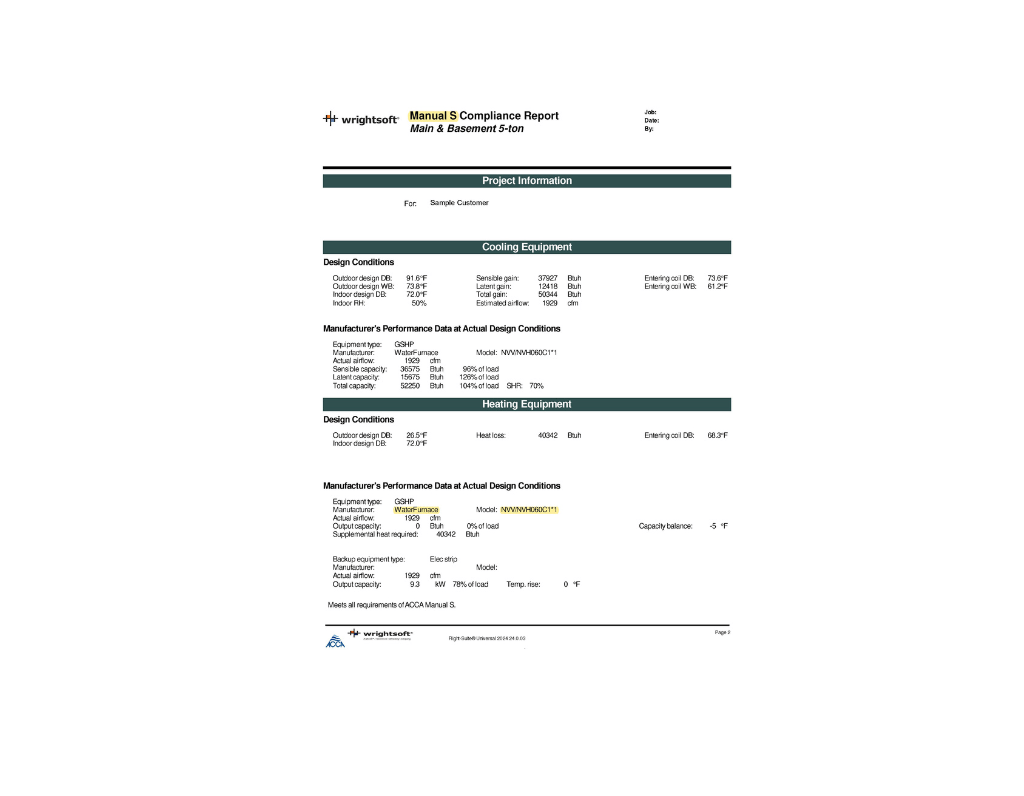
A proper Manual S document — typically 2–4 pages — connects the load to the selection and shows: project design conditions; Manual J total, sensible, and latent cooling loads; Manual J heating load; selected equipment model numbers; manufacturer performance data at actual design conditions; sensible and latent capacity verification; oversizing check (sensible capacity ÷ sensible load ≤ 115%); heating capacity at winter design temp; and balance point with backup heat sizing for heat pumps. We produce Manual S as part of a J+S or J+S+D package, and as a standalone service. Residential and light commercial, nationwide.
Frequently asked questions
What is a Manual S residential equipment selection PDF?
The document that shows a system was selected based on verified performance data at actual design conditions — not just nameplate ratings at AHRI standard conditions. It confirms sensible and latent capacity, checks the 15% oversizing limit, and establishes the heat pump balance point where applicable.
Why isn’t AHRI capacity the same as actual capacity?
AHRI ratings are measured at 95°F outdoor, 80°F indoor DB, 67°F indoor WB. At 100°F outdoor, a system typically delivers 8–12% less cooling than its nameplate. Manual S uses manufacturer expanded performance tables to find actual output at your design conditions.
What is sensible heat ratio and why does it matter?
SHR is the fraction of total cooling capacity going toward reducing temperature vs. removing moisture. In humid climates, a system that meets the temperature load but not the moisture load leaves a house cool and clammy regardless of how the thermostat is set.
Why is there a 15% oversizing limit?
ACCA Manual S limits single-stage equipment to no more than 15% over the calculated sensible load because oversized equipment short-cycles — it cools the air quickly and shuts off before the coil has time to remove meaningful moisture.
Do you provide Manual S for light commercial projects?
Yes — residential primarily, with select light commercial including small offices, recreation centers, and similar occupancies. Same Manual S methodology, same permit-ready output.
A Manual S report that checks sensible, latent, and oversizing against your actual design conditions — not just nameplate at standard test conditions.
See pricing & get started →